•
•
•
•
•
•
•
•
•
•
•
•
•
•
•
•
•
•
•
•
•
•
•
•
•
•
•
•
•
•
•
•
•


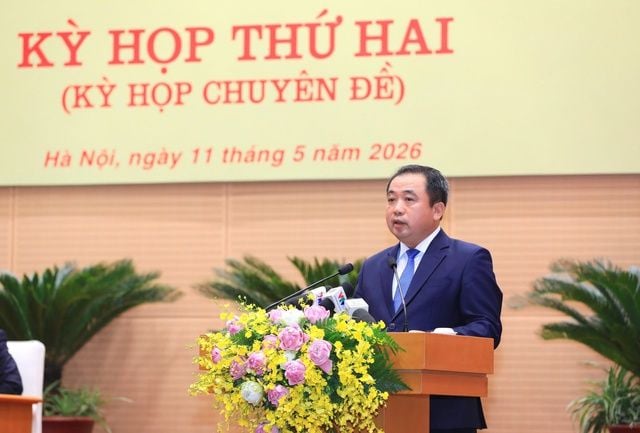
On the morning of May 11, Politburo member and Hanoi City Secretary Tran Duc Thang delivered a directive at the city’s second session (special session) of the Hanoi People’s Council. He said Hanoi is entering key historical milestones, with a complete legal framework and strategic direction for development in the new era, and that the session is the first step toward concretizing the Capital Law of 2026.
The Secretary emphasized that Hanoi must not delay in institutionalizing the law and must not be hesitant in implementation. He called for the law to be enacted proactively, moving “one step ahead” to turn special mechanisms into real development resources for the capital.
Tran Duc Thang said that with the Capital Law of 2026, the 100-year capital plan approved by the People’s Council, and a development model proposal expected to be approved by mid-2026, Hanoi has an opportunity to make a breakthrough in the new era.
He also stressed that the quality of the People’s Council’s resolutions is central to effective rollout. Members were asked to discuss openly, focusing on feasibility and actual effectiveness of each policy.
“Resolutions must specify the purpose, authority, resources, timeline, and product; once issued, they must be implementable immediately, not left on paper,” the Secretary said. He urged the city to avoid over-cautiousness that delays implementation, while also ensuring work is not sloppy and that procedural obstacles do not hinder the law’s rollout.
Regarding budget allocations for science and technology, innovation, and digital transformation, the Secretary said these should be treated as investments in development capacity. He called for budgets to target the right objects and objectives and to produce substantive change, while avoiding dispersion and formality.
For major infrastructure projects, Tran Duc Thang called for converting special mechanisms into concrete progress at project sites. For large, important projects under Resolution 258/2025/QH15, he set a clear expectation that special mechanisms must translate into tangible construction momentum.
He noted that the projects considered at this session are significant for infrastructure, environment, healthcare, transportation, and urban space development.
The Secretary urged the City People’s Council, when reviewing investment policies or adjusting them, to focus on five issues: necessity; socio-economic and economic–social effectiveness; the ability to balance resources; implementation progress; and the responsibility of the lead agency.
He said the council should not approve projects merely to complete procedures, and should not include projects with unclear resources, unclear land, or unclear timelines. He added that any approved project must have a responsible unit and a person accountable for outcomes.
On the 2026–2030 land clearance list, Tran Duc Thang asked that residents be placed at the center of implementation. He said compensation, support, and resettlement must be transparent, lawful, and carried out decisively to balance the interests of the state, residents, and enterprises.
Based on Resolution 258/2025/QH15, the major and important projects in Hanoi include:
Public investment projects under the Investment Law, PPP projects under the PPP Law, and investment projects under the Investment Law that must be implemented immediately per directives of the Politburo, the Secretariat of the Party Central Committee, the Government Party Committee, and the Hanoi Party Committee.
Public investment and PPP projects meeting the criteria of national-important projects; public investment and PPP projects using local budgets or other legitimate local funds with total investment of 30,000 billion VND or more.
Investment projects within the list of projects attracting strategic investors under the Capital’s regulations with investment of 30,000 billion VND or more.
Renovation, remodeling, and urban redesign projects, including rebuilding housing blocks under housing regulations; renovation or redesign of one or more urban blocks.
New investment or renovation of works to address bottlenecks, traffic congestion, flooding, or environmental degradation.
Premium gym chains are entering a “golden era” that is ending or already in decline, as rising operating costs collide with shifting consumer preferences toward more flexible, community-based ways to exercise. Long-term memberships are shrinking, margins are pressured by higher rents and facility expenses, and competition from smaller, more personalized…