•
•
•
•
•
•
•
•
•
•
•
•
•
•
•
•
•
•
•
•
•
•
•
•
•
•
•
•
•
•
•
•
•


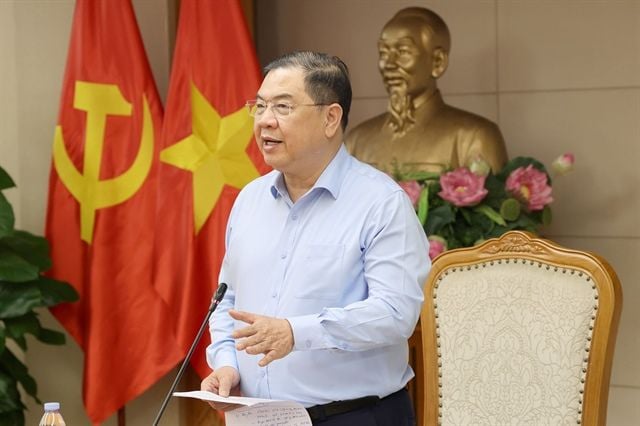
Acting Deputy Prime Minister Pham Gia Tuc has emphasized that partner selection for technology transfer is a prerequisite for Vietnam’s North-South high-speed railway project, linking any technology transfer partner choice directly to the goal of transferring technology to Vietnam. The Government Office has issued conclusions from the Acting Deputy Prime Minister’s meeting on the progress of the North-South high-speed rail project and other railway lines.
The Acting PM said the North-South high-speed rail and related projects are important and represent a new, complex field with many difficulties, requiring decisive involvement across the political system. He stressed that implementation must include a comprehensive assessment of economic, political, diplomatic, and efficiency factors, ensuring economic-financial efficiency and alignment with the railway industry’s self-reliant development orientation. He also called for an appropriate management and operating model.
Ministries, sectors, and localities were asked to ensure progress, quality, and investment efficiency within their authority, without shifting responsibility or avoiding accountability. Localities along the routes were instructed to promptly carry out site clearance after the Ministry of Construction provides documents and boundary markers.
The Ministry of Construction and related agencies will continue reviewing and proposing amendments to complete the legal and institutional framework for railway investment, management, and operation, to ensure effectiveness under Vietnam’s practical conditions.
The Ministry of Science and Technology and the Ministry of Construction were tasked with promptly reviewing, developing, and issuing supplementary standards and codes for railways—including high-speed rail, standard-gauge rail, and urban rail—so they are suitable for Vietnam while aligned with international practice to enable uniform nationwide application.
The Acting PM noted that urban rail standards should be completed by June for nationwide application, including consideration of connections with the national railway system.
For items where Vietnam lacks machines, equipment, or new technology, the Ministry of Construction was assigned to coordinate with partners to receive, evaluate, and establish project-specific unit-cost benchmarks, with a roadmap toward broader application. The technology transfer partner selection for the North-South high-speed rail project must be linked to the prerequisite of technology transfer to Vietnam.
For the North-South high-speed rail project, the Ministry of Construction must promptly complete procedures to select consultants to prepare the feasibility study in Q2. Localities were asked to promptly plan to maximize the economic benefits of the North-South high-speed rail.
The Acting PM also emphasized that procedures, standards, technical quality, and project efficiency should not be sacrificed under schedule pressure, and that absolute safety must be ensured throughout the project life cycle.
If investment policy adjustments are required, the Ministry of Construction should complete the submission documents to the Government in May and to the Standing Committee in June.
For the Lao Cai–Hanoi–Hai Phong railway, the Ministry of Construction should promptly review and evaluate consultants’ proposals for the feasibility study to ensure project efficiency and a long-term vision, connecting economic centers and coordinating transport modes.
Regarding Hanoi and Ho Chi Minh City’s urban rail projects, the Acting PM asked Hanoi and Ho Chi Minh City to coordinate with the Ministry of Construction and other agencies to accelerate project progress and remove obstacles in investment procedures, site clearance, funding, and technology. He also requested ensuring safe and efficient operation, climate adaptation, and alignment with approved planning.
For new projects, the Acting PM said careful study and selection of suitable, coordinated technologies with a reasonable investment timeline should be pursued according to local budget constraints to avoid dispersal.
Trần Thường. VietNamNet.
Premium gym chains are entering a “golden era” that is ending or already in decline, as rising operating costs collide with shifting consumer preferences toward more flexible, community-based ways to exercise. Long-term memberships are shrinking, margins are pressured by higher rents and facility expenses, and competition from smaller, more personalized…