•
•
•
•
•
•
•
•
•
•
•
•
•
•
•
•
•
•
•
•
•
•
•
•
•
•
•
•
•
•
•
•
•


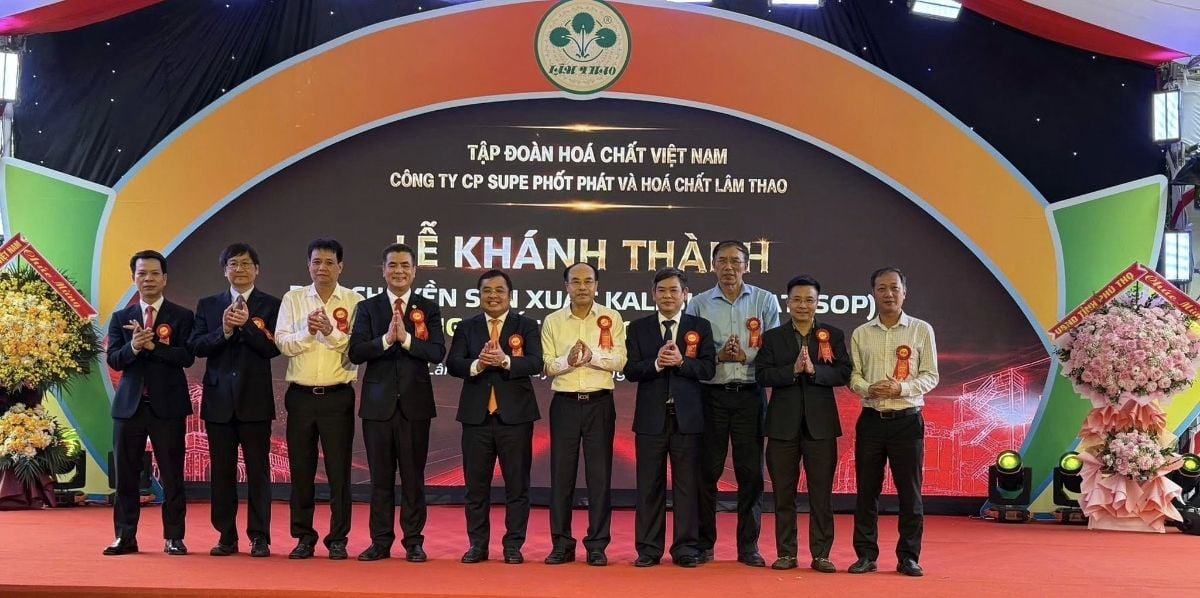
On May 7, 2026, Supe Phốt phát và Hóa chất Lâm Thao Joint Stock Company officially inaugurated a potassium sulfate (SOP, K2SO4) production line with a capacity of 20,000 tons per year. The project is positioned as a milestone for both the company and Vietnam’s fertilizer industry amid global volatility affecting agricultural inputs, including geopolitical risks, disrupted supply chains, and food security pressures.
The new SOP production line is described by the company as one of the first industrial-scale SOP complexes in Vietnam’s northern region. The project began in June 2025 and completed installation and commissioning in April 2026.
Supe Lâm Thao said the line is intended to diversify high-quality fertilizers and gradually complete an environmentally friendly product ecosystem for modern agriculture. The company also stated that the SOP Lâm Thao project is aimed at export markets.
A key feature of the project is the use of Mannheim furnace technology, which the company described as leading global SOP production technology. According to Supe Lâm Thao, the technology supports tight control of operating parameters, optimizes raw material use, improves product quality, and reduces environmental emissions.
The integrated DCS control system is intended to increase automation, reduce operational errors, and ensure production safety.
For input materials, the company said it uses potassium chloride (KCl) imported from Canada with an effective K2O content of 62% or higher, with high purity and low impurities. It also produces sulfuric acid (H2SO4) from elemental sulfur using modern technology to support SOP production with stable quality.
At the inauguration, Mr. Pham Thanh Tung, CEO of Supe Phốt phát và Hóa chất Lâm Thao, said SOP is a chlorine-free high-grade fertilizer suitable for crops sensitive to chlorine, including tea, coffee, pepper, tobacco, vegetables, and fruit trees—particularly in export-oriented production regions.
“Removing chlorine helps limit soil hardening and salinization while improving crop color, gloss, aroma, and post-harvest shelf life.”
The project also includes an HCl gas recovery system designed to produce commercially pure hydrochloric acid with a capacity of 24,000 tons per year. The company said emissions meet QCVN 19:2024 and that the approach supports a circular economy by turning waste into inputs for sectors including water treatment, pharmaceuticals, food, textiles, and chemicals.
With domestic SOP supply still limited and heavily dependent on imports, Supe Lâm Thao said the investment is expected to help secure high-quality fertilizer supply for domestic production and create future export opportunities.
Under its plans, the company said it will continue expanding production scale, research new fertilizer generations, and gradually integrate the SOP Lâm Thao brand into regional and global supply chains.
Dr. Phung Ha, Chairman of the Vietnamese Fertilizer Association, said developing SOP production domestically has strategic significance for Vietnam’s agriculture. He noted that in a more globalized world, countries increasingly rely on raw materials, energy, and goods, and that domestically producible products with competitive prices and suitable quality should be prioritized—especially essential goods tied to national security and economic independence.
“Fertilizers are strategic goods because agriculture has proven to be a backbone of the economy, and fertilizers are a crucial input for farming,” Dr. Phung Ha emphasized.
He also highlighted how geopolitical disruptions can expose vulnerabilities in fertilizer supply chains. He cited past events including the 1973 Egypt–Israel conflict, which contributed to global spikes in energy and fertilizer prices, and the 2022 Russia–Ukraine conflict, which disrupted potash and ammonia and affected Europe and beyond. More recently, he said tensions between the US, Israel, and Iran in 2025–2026 have continued to pressure fertilizer markets, particularly feedstocks such as sulfur, ammonia, and sulfuric acid.
Dr. Phung Ha pointed to the disruption of the Hormuz Strait, which he said is a critical route for nearly 50% of world sulfur shipments, as a factor that has driven sulfur prices higher and increased production costs for fertilizers.
In this context, the operation of a 20,000 t/year SOP line is described as a positive signal for Vietnam’s fertilizer sector. Dr. Phung Ha said SOP is regarded as a high-value fertilizer globally because it provides potassium and sulfur without chlorine. He added that compared with MOP (potassium chloride), SOP has lower salt content and is particularly suitable for salt-sensitive crops such as fruits, vegetables, tea, and coffee.
He also cited global usage and market scale: by the end of 2024, global SOP production exceeded 7 million tons. China was described as the largest consumer with more than 3 million tons per year, while Europe and North America each consume over 1 million tons. Dr. Phung Ha said more than 50 countries worldwide use SOP for high-value crops, and noted that SOP is sometimes called “sweet potassium” because it can help improve the quality, sweetness, and appearance of exported crops such as durian, oranges, and lemons.
On the broader potassium market, the article cited that the global MOP market was valued at about USD 64.6 billion in 2023, rising to about USD 76.1 billion in 2024, and projected to reach over USD 90 billion by 2030.
Premium gym chains are entering a “golden era” that is ending or already in decline, as rising operating costs collide with shifting consumer preferences toward more flexible, community-based ways to exercise. Long-term memberships are shrinking, margins are pressured by higher rents and facility expenses, and competition from smaller, more personalized…