•
•
•
•
•
•
•
•
•
•
•
•
•
•
•
•
•
•
•
•
•
•
•
•
•
•
•
•
•
•
•
•
•


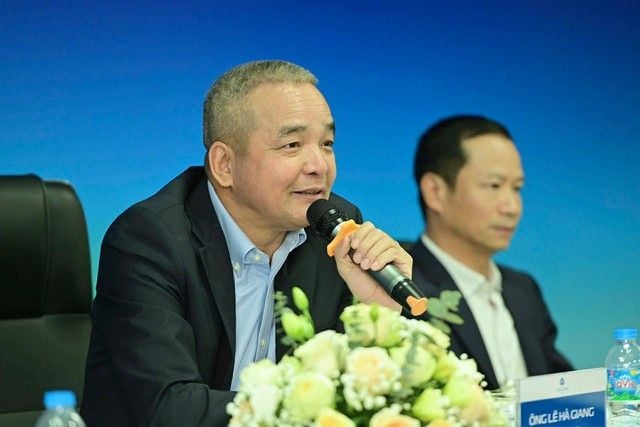
Long Giang Land’s Chairman Le Ha Giang said the company’s 2026–2030 development strategy targets positioning the firm among the top mid-sized real estate enterprises, supported by sound financial governance and safety.
In 2026, Long Giang Land plans to focus on developing and commercializing Rivera-branded real estate projects. The company expects the largest revenue contribution to come from the handover of 288 units in Rivera Park Saigon Block C (Thanh Thai project) to the Ho Chi Minh City People’s Committee, valued at 289 billion dong.
Revenue expected from two other projects—Rivera Park Can Tho and Rivera Thien Hoa—is 245 billion dong.
At the annual general meeting, shareholders approved the 2025 dividend plan of 12% per par value. With 51.5 million outstanding shares, the company plans to pay approximately 62 billion dong in cash dividends. The source will be undistributed after-tax profits as of 31/12/2025. For 2026, the company plans a dividend rate of 9%.
Alongside dividends, Long Giang Land plans to increase charter capital from 515 billion dong to 1,030 billion dong through a rights issue to existing shareholders. The company will offer 51.5 million shares at a rights issue ratio of 1:1. The issue price will be no lower than 10,000 dong per share, based on the 2025 year-end book value of 13,544 dong per share.
The mobilized funds are planned to be used to develop the Rivera Park Can Tho shopping complex, offices, and residential area, and to receive 100% of the contributed capital of DP Investment Co. Ltd. DP Investment currently has a business cooperation contract for a mixed-use building in Hanoi called Dong Phat.
Under the 2026–2030 strategy, Chairman Le Ha Giang said the company aims to be “among the best” rather than pursuing rapid scale. Long Giang Land also targets maintaining its status as a listed company with transparency, stability, and long-term growth.
Over the next five years, the company set targets including charter capital of 3,000 billion dong, market capitalization of 5,000 billion dong, minimum revenue of 5,000 billion dong per year, and profit above 500 billion dong per year.
On the feasibility of the strategy, Chairman Le Ha Giang cited the scale of Vingroup and Dat Xanh. Vingroup has charter capital over 700,000 billion dong and market capitalization of about 1.6 quadrillion dong, while Dat Xanh has charter capital of 11,000 billion dong and market capitalization of 16,000 billion dong—both several times larger than Long Giang Land. He said the plan was built carefully and that Long Giang Land intends to operate in a niche while aiming to be the best.
Regarding Long Giang Land’s stock, the chairman said the price depends on intrinsic strength and market context. He noted that past results were weak and that the business outlook is only now improving, adding that the market price has hovered around 50% of book value due to limited investor trust.
He also stated that the company has “hardly lost assets” over the past five years, saying current assets are valued at least double compared with five years ago. He emphasized that stock price recovery would depend on strengthening internal capabilities and improving market confidence.
In response to concerns about asset leakage, he pledged: “Not a single asset will be lost.”
On Lot C Rivera Park Saigon, the chairman said Ho Chi Minh City’s merger with Vung Tau and Binh Duong has increased demand for government housing. He said Lot C was selected to serve public housing buyers and that legal issues have been resolved five to ten times faster than before.
On tax debts, the chairman said proceeds from Lot C and the Viet Hung project will be sufficient to settle them.
Shareholders asked why there is no further cash dividend. The chairman said 2025 profits are sufficient to pay a 12% dividend, and that upcoming receipts of 300–400 billion dong will be used to settle taxes and distribute cash dividends to thank shareholders for their support in the prior year. He also said paying in stock would be “somewhat unfair.”
Shareholders holding more than 1 million shares expressed disappointment and pressure but also viewed the meeting’s signals positively. One shareholder said they agreed with the leadership’s stance on a 12% dividend and urged the leadership to promptly implement cash dividends.
Premium gym chains are entering a “golden era” that is ending or already in decline, as rising operating costs collide with shifting consumer preferences toward more flexible, community-based ways to exercise. Long-term memberships are shrinking, margins are pressured by higher rents and facility expenses, and competition from smaller, more personalized…