•
•
•
•
•
•
•
•
•
•
•
•
•
•
•
•
•
•
•
•
•
•
•
•
•
•
•
•
•
•
•
•
•


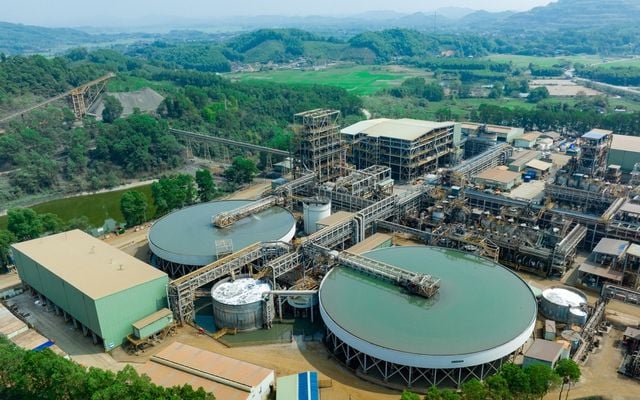
Masan High-Tech Materials (UPCoM: MSR) reported strong results for Q1 2026, with quarterly profit reaching a record high. Revenue rose to 2,993 billion dong, up 115% year on year, while net profit after tax climbed to 537 billion dong—the highest quarterly profit to date.
The company said the main growth driver came from its tungsten segment. Tungsten revenue reached 2,445 billion dong, up 218% year on year.
MSR expects the momentum to continue into Q2 2026. Preliminary April results indicate Q2 net profit of around 690 billion dong.
From the second half of the year, the outlook could improve further as ore processing production recovers and ramps up from Q3 following an additional mining license adjustment of 28 million tonnes.
While the APT price range is cited at about 2,000–3,000 USD/mtu, MSR’s 2026 plan is based on a more conservative APT price scenario of around 1,200 USD/mtu.
Under this plan, MSR targets 2026 revenue of about 16,000–20,300 billion dong, representing nearly a threefold increase versus the previous year. Net profit after tax is expected to reach 1,700–2,500 billion dong, equivalent to roughly 150–220 times growth compared with 2025.
MSR’s margin outlook is supported by the tungsten price rally, which is linked to tighter global supply conditions amid China’s production and export controls. Ammonium paratungstate (APT)—an intermediate tungsten product—rose from about 315 USD/mtu in early 2025 to above 3,100 USD/mtu in early 2026.
As prices rise, MSR expects cash flow generation to improve. At the company’s 2026 AGM, management indicated that for every $100 increase in price above the assumed 1,164 USD/mtu, revenue would increase by about $50 million and net income by about $10 million.
Looking further to 2027–2033, MSR’s profit could exceed $500 million per year even if APT remains at 1,500 USD/mtu.
If APT prices stay around 1,500 USD/mtu, the company expects to be cash flow positive by late 2027 or early 2028.
MSR noted that most operating costs and fixed investments have already been set. As output and prices increase, revenue growth can translate into profits more quickly. If the 2026 revenue target above 20,300 billion dong is achieved, the company could expand operations by nearly three times versus the previous period.
MSR is also nearing a plan to switch listing from UPCoM to HOSE. Management said the move could improve liquidity, broaden the investor base, and better reflect the company’s value.
MSR’s long-term outlook is supported by rising global demand for strategic minerals driven by AI, semiconductors, and electronics—sectors that require high-strength, heat-resistant, and high-precision materials.
As the global strategic minerals supply chain reshapes, MSR’s resource endowments and deep processing capabilities position it to shift from cyclical performance toward more structural growth, supporting a longer-term and more sustainable expansion runway.
Premium gym chains are entering a “golden era” that is ending or already in decline, as rising operating costs collide with shifting consumer preferences toward more flexible, community-based ways to exercise. Long-term memberships are shrinking, margins are pressured by higher rents and facility expenses, and competition from smaller, more personalized…