•
•
•
•
•
•
•
•
•
•
•
•
•
•
•
•
•
•
•
•
•
•
•
•
•
•
•
•
•
•
•
•
•


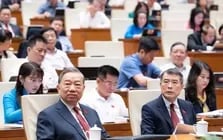
On the afternoon of April 23, with the overwhelming majority of National Assembly deputies voting in favor, the National Assembly approved the Capital City Law (amended).
During the discussion and reception of opinions on the draft Capital City Law (amended), Justice Minister Hoàng Thanh Tùng said the Government conducted a comprehensive review of the draft law to fully institutionalize Resolution No. 02 and other pillar resolutions of the Politburo, in line with the requirement to reform thinking in lawmaking.
He added that the drafting committee also reviewed and focused on devolution and delegated authority to the capital administration, linked to establishing a mechanism for checks on power, increasing accountability, and ensuring transparency in implementation.
The mechanisms, special policies, and overriding powers—while delineating powers among city-level authorities—will be refined as follows: the People’s Council decides major policies; the People’s Committee defines procedures for implementation; and the Chairman of the People’s Committee leads, directs, and coordinates implementation.
After receiving and revising the draft Law on giving the city government 199 special, overriding powers, the final structure is:
Minister Hoàng Thanh Tùng said these provisions create a coherent legal basis for the city to maximize its potential, status, and initiative in building and developing the capital under the motto “Local decides, local executes, local responsible.”
In response to deputies’ opinions, the draft law was revised to affirm the proactive role of the capital’s government in policy design and implementation and to tighten rules, including:
The draft law adds a scope for pilots, including “other mechanisms and policies under directives of competent authorities” to ensure comprehensiveness.
It also sets a pilot period for new policies of no more than five years, with a suspension mechanism if risks arise beyond forecast.
Regarding special mechanisms and policies for capital development, the draft states that policies are reviewed and refined to be robust, feasible, and controllable, ensuring supervision and practicality.
Specifically, the draft clarifies the city’s authority in planning and space development and requires coordination with relevant ministries to ensure tight control, especially for high-rise spaces.
The regulation allows the City People’s Committee to add local education programs without changing the core goals and content of national education programs.
It also refines health policies by specifying responsibilities of local health facilities in supporting the capital’s health system, especially in out-of-hospital emergency care and coordinated health care.
The draft entrusts the Hanoi People’s Council to apply special mechanisms and policies for large, important projects based on consent of competent authorities and after consultation with relevant ministries.
It also allows extending the start of construction by up to six months to meet conditions for projects implemented under National Assembly Resolution No. 258.
On the “capital region” and regional linkage, the draft affirms the central role of the capital; creates mechanisms for localities to actively participate in linkages; and applies Capital Law provisions when implementing joint projects.
It also allows using local budgets to invest regionally to address infrastructure, environmental, and essential services for the common good.
Notably, the draft law states the principle of excluding legal liability for cases carried out within authority and procedures, and not for personal gain, even if damage occurs. Minister Hoàng Thanh Tùng said this is part of the overall framework of power control, oversight, and accountability.
The Capital City Law (amended) takes effect from July 1, 2026.








Premium gym chains are entering a “golden era” that is ending or already in decline, as rising operating costs collide with shifting consumer preferences toward more flexible, community-based ways to exercise. Long-term memberships are shrinking, margins are pressured by higher rents and facility expenses, and competition from smaller, more personalized…




