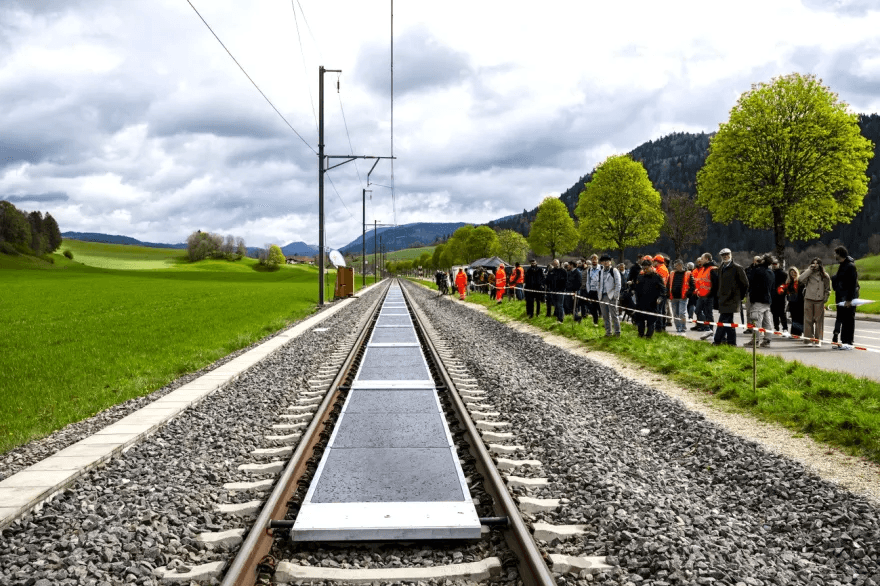
Sun-Ways' one-year trial of solar panels installed between railway tracks in Europe ended earlier than planned, marking what the company says is the world's first solar photovoltaic installation on railway infrastructure. The test, announced via Euronews, concluded after one year instead of three.
The project aims to turn railway tracks into solar power plants by leveraging existing rail corridors, addressing land-use constraints while supporting energy supply for rail networks and local grids. The Swiss Innovation Promotion Agency backs the initiative, which began with 100 meters of photovoltaic panels installed between rails in the village of Buttes, Val-de-Travers, Switzerland, last year.
The system fed into the local grid and produced 16,000 kWh in just over a year, while accommodating 11,000 trains. The electricity generated is enough to power about 3–4 households for a year. Sun-Ways founder Joseph Scuderi said the system was “completely stable and safe during operation.” The trial’s success has spurred scale-up potential across Europe, with next pilot projects planned in Italy, France and the Netherlands; the Italy project is due to begin in a few months. In France, Sun-Ways signed with SNCF, which manages about 28,000 km of rails and is a large consumer of industrial electricity.
In Asia, the company is negotiating similar projects with partners in Korea, China, India, and Singapore. The Korea project has been approved by the government near Osong station, Chungcheongbuk-do, with a two-year pilot and potential nationwide expansion.
Analysts remain cautious about storage and transmission; Julien Pouget, associate professor at the University of Applied Sciences Valais, says current technology may not be suitable to transmit electricity from solar-on-track projects beyond 500 meters. Founder Scuderi hopes to address this by tying production to railway substations or delivering power directly to trains rather than feeding the local grid.
Switzerland-wide scale: if solar panels were installed on the entire 5,317 km rail network, the solar electricity produced could reach 1 TWh, representing about 2% of the country’s total electricity consumption. Sun-Ways representatives estimate that the scale of solar coverage would be 50,000 times the test range, equivalent to 760 football pitches.
Europe-wide context: in Q1, renewable electricity accounts for nearly 46% of Europe’s energy supply, with solar power the third-largest source after wind and hydro. A key constraint for solar is land use; rail-integrated PV addresses this by using existing transportation infrastructure and space.
Operational observations: tests indicate rail-integrated PV does not require cleaning, as airflow from trains traveling up to 90 km/h sweeps away dust. TransN, the public transport company of the canton of Neuchâtel, confirmed that the solar energy system on rails does not affect regular rail operations, and glare concerns were noted by analysts but no issues were reported during testing.
Analysts remain cautious about storage and transmission capabilities. Julien Pouget, associate professor at the University of Applied Sciences Valais, notes that current technology may not be suitable to transmit electricity from solar-on-track projects beyond about 500 meters. Scuderi remains focused on expanding production connections—either to railway substations or directly to trains—to minimize reliance on feeding the local grid.
Following the initial success, Sun-Ways hopes governments will accelerate pilots and confirm the project’s viability. If approved, this technology could turn thousands of kilometers of rail into a new energy source and spur further pilots across Europe and beyond.
Attributions: Bảo Bảo (according to Euronews, Swissinfo).