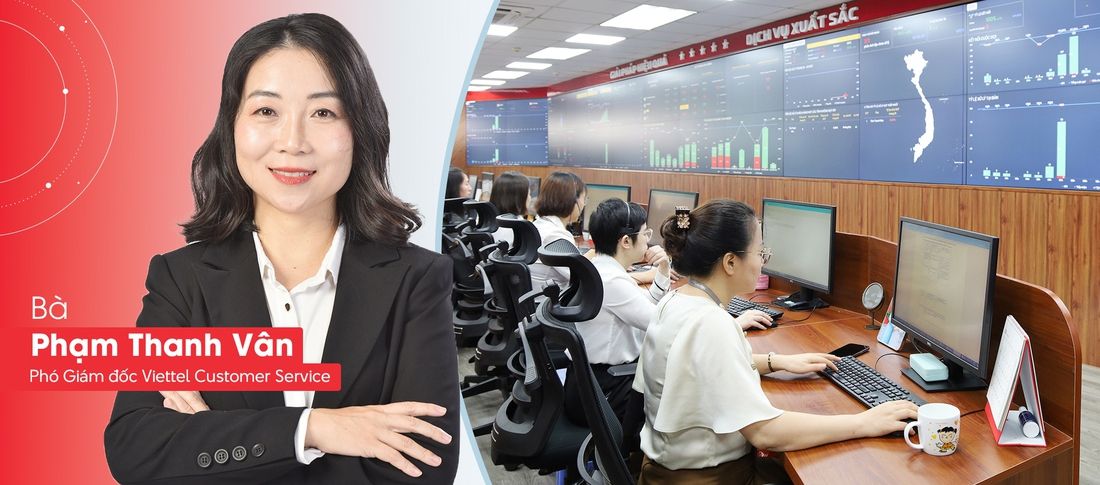
The transformation of Viettel's Call Center into Viettel Customer Service (VCX) marks a shift from a voice-focused support hub to a technology-driven platform that manages customer experience at scale in the AI era.
The spread of smartphones and mobile apps, along with chatbots and AI, led customers to move away from voice calls toward digital interactions on platforms like Zalo, Messenger, Viber, or a company's own apps. Calls that were once the lifeblood of the Call Center began to wane, while the role expanded to overseeing the entire customer journey across digital touchpoints. In 2020, a Viettel Group leader reframed the center’s core capability: instead of simply handling calls, the capability is to organize the machinery and operate at scale. This insight laid the foundation for a new approach to customer experience management in the AI era.
The shift was not merely a rebranding. It signaled a move from selling call-center services to delivering a technology-driven capability to understand user behavior, operate data, and manage customer experience at scale.
The idea evolved into the creation of Viettel Customer Service (VCX), a company that aims to manage the entire customer journey across digital environments rather than focusing solely on call handling. VCX represents a fundamental change in business model: applying an operating capability—built from millions of calls—to the AI era and beyond. It is not just about providing a response service; it is about enabling seamless experiences across multiple channels and platforms.
VCX emphasizes that customers no longer need to rely on a person answering a call; they require a seamless experience across touchpoints. For mobile operators, value has shifted from voice services to 4G/5G data infrastructure to support the digital ecosystem. This evolution reframes Viettel’s Call Center as a component of a broader, AI-enabled customer-experience management system.
VCX is positioned not as just another call-handling service, but as an operating capability to solve customer problems at scale. It aims to apply the accumulated experience of handling millions of requests to manage customer experiences across digital platforms, design processes, monitor quality, and understand customer needs deeply. The company emphasizes that the phone is only a tool; the operating capability is what creates value. Its philosophy includes a “customer zero” approach—prioritizing system design so that issues do not arise in the first place and reducing the need for customers to call.
Key ideas include: AI can answer repetitive questions and operate around the clock, but humans design the customer journey; AI handles millions of interactions, while people decide the path customers take. VCX seeks to apply this capability to other companies’ problems and to open a new market in AI-era customer-experience management.
The aim is not to be the fastest resolver of issues, but to design a system where customers rarely encounter problems requiring outreach. This reflects a broader shift from measuring success by the number of calls answered to measuring success by the number of calls customers do not have to make.
Leadership for VCX comes from the technology sector. Since its inception, the leadership has included technology engineers from Viettel, notably Truong Quang Viet, the current VCX Director, who previously oversaw the software center with about 1,000 Viettel engineers (2013–2014) and who was the former Deputy General Director of Viettel Digital Services. His predecessor was Nguyen Tien Dung (former CEO of Mytel – Viettel Myanmar). This leadership profile reinforces the view that VCX is a technology company focused on customer-experience management rather than a traditional call-center operator.
As AI, data, and digital platforms become growth engines, technological thinking is presented as a prerequisite for development. VCX defines the Call Center in the AI era not as an adversary but as a partner: AI handles repetitive tasks while humans design the journey; AI processes millions of interactions, and humans chart the customer path. The company envisions a future where VCX helps other companies improve their customer experiences by leveraging its operating capability, moving beyond being a single-service provider to becoming a broader technology-driven platform.