•
•
•
•
•
•
•
•
•
•
•
•
•
•
•
•
•
•
•
•
•
•
•
•
•
•
•
•
•
•
•
•
•


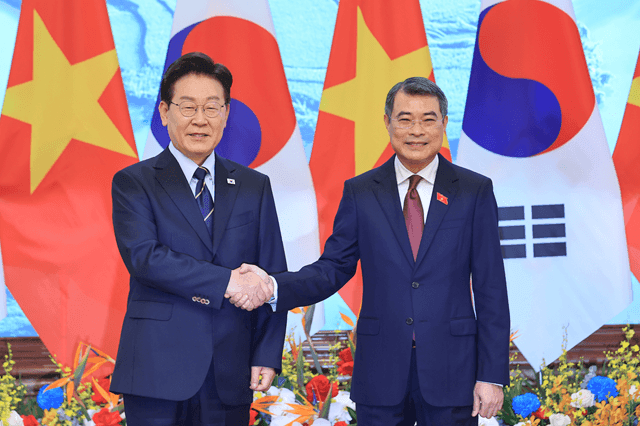
South Korea has expressed interest in participating in Vietnam’s strategic infrastructure projects, including nuclear power and high-speed rail, as the two countries seek to deepen substantive economic cooperation.
During a meeting on April 23, 2026, Vietnamese Prime Minister Le Minh Hung and South Korean President Lee Jae Myung agreed to expand cooperation with a focus on allowing South Korean companies to take part in large-scale projects in Vietnam. South Korea highlighted sectors such as nuclear power, infrastructure, and especially high-speed rail, describing them as projects with very large total capital that directly affect Vietnam’s industrialization in the coming period.
Both sides emphasized improving the quality of cooperation rather than simply increasing its scale. Prime Minister Le Minh Hung proposed increasing localization and enabling deeper participation by Vietnamese firms in the South Korean supply chain, moving beyond a role limited to subcontracting.
President Lee Jae Myung, in turn, affirmed support for Vietnamese enterprises to participate more deeply in the global supply chain. The two leaders also discussed efforts to raise bilateral trade to 150 billion USD by 2030 in a more balanced direction.
Korea remains Vietnam’s largest investor, with more than 10,000 enterprises operating in the country. The relationship between the two nations, after nearly 35 years of establishment, has expanded across multiple areas including the economy and technology, as well as labor and education.
Beyond economic cooperation, the leaders also discussed long-term collaboration in science and technology, digital transformation, and human resource development. South Korea urged Vietnam to continue addressing obstacles faced by Korean enterprises to enable deeper participation in future major projects.
On the same day, leaders from both countries attended a business forum and the Vietnam-Korea Economic Forum. Representatives from major groups on both sides exchanged opportunities for cooperation in industry, investment, and technology.
Premium gym chains are entering a “golden era” that is ending or already in decline, as rising operating costs collide with shifting consumer preferences toward more flexible, community-based ways to exercise. Long-term memberships are shrinking, margins are pressured by higher rents and facility expenses, and competition from smaller, more personalized…