•
•
•
•
•
•
•
•
•
•
•
•
•
•
•
•
•
•
•
•
•
•
•
•
•
•
•
•
•
•
•
•
•


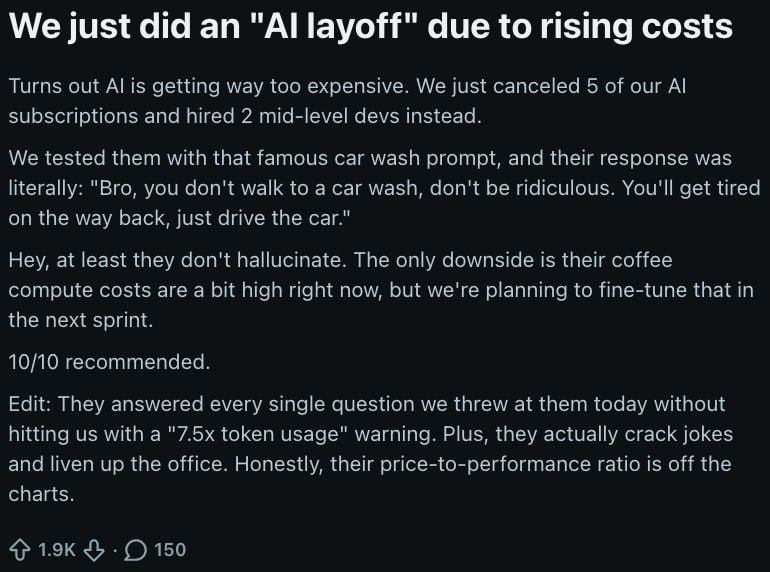
Artificial intelligence was once expected to replace workers and reduce operating costs for businesses. Instead, a growing number of companies are reportedly cutting back on AI usage and hiring traditional software developers again, citing rising costs of maintaining AI platforms.
The discussion began with a post on Reddit’s r/ClaudeCode forum. The author described a company decision to cancel five paid AI subscriptions in order to free budget for two mid-level developers.
To evaluate the new hires, the company used a well-known logic trap about a car wash: whether someone should walk 100 meters to the car wash or drive 100 meters. According to the post, AI models often respond with mechanical, step-by-step walking directions. The two developers, by contrast, reportedly gave a decisive answer: “Nobody walks to the car wash; just drive there.”
The author said the advantage of human programmers is that they do not suffer from “hallucinations” or fabricated information. The manager also joked that the only drawback is the cost of “coffee computation” (human effort), which they planned to adjust in the next round of work.
The post adds that the two hires solved technical questions that day without triggering “token overage” errors and even helped make the office atmosphere more lively. The author concluded that the performance-per-cost ratio of human programmers is extremely high under current conditions.
Beyond the anecdote, the post points to a practical cost issue for software teams: AI programming tools and API usage can become expensive as workloads scale.
The launch of Claude Code from Anthropic is cited as an example of how AI usage costs may no longer be as affordable as before. The post references pricing tiers indicating that a basic Pro package at 20 USD per month may be suitable for minor debugging, while production work requires upgrading to a Max package at about 100–200 USD per month. For team settings, it cites a Team Premium tier at 125 USD per month per seat.
It also notes that costs can rise further when using pay-as-you-go API models. For Opus 4.7, the post states that input tokens cost about 5 USD per million and output tokens about 25 USD per million. For tasks that involve scanning entire codebases and reorganizing architectures, it says token consumption can reach tens of dollars in an hour.
According to the post, there have been reports of monthly API bills reaching around 2,500 USD. It argues that when platform costs reach tens of thousands of dollars per year, hiring staff in person can become a more economical option.
The post frames the situation as a commercialization challenge: early-stage technology often subsidizes usage to attract customers, but as models become more complex and require more computing power and servers, price increases can be difficult to avoid.
It also presents a blunt comparison: operating AI invoices can end up costing more than the monthly salary of a mid-level software engineer in many regions.
Not all readers accepted the story at face value. One skeptical user argued the post was not a real article and accused it of astroturfing, questioning how a Claude AI package costing 100–200 USD (or multiple packages) could compare with the salary of two mid-level developers. The discussion also reflects differing views on programmer salary levels across regions.
Other commenters focused on the trade-offs of reducing “coffee computation.” One user warned against cutting human effort too much, saying programmers can become frustrated if underlying resources are scarce. Another described a failed experience hiring humans, saying administrative time turned into a disorganized “nap party” in the office.
Overall, while the story is presented with humor, it is used to highlight a cost problem that is increasingly central to software teams weighing AI tools against traditional staffing.

Premium gym chains are entering a “golden era” that is ending or already in decline, as rising operating costs collide with shifting consumer preferences toward more flexible, community-based ways to exercise. Long-term memberships are shrinking, margins are pressured by higher rents and facility expenses, and competition from smaller, more personalized…