•
•
•
•
•
•
•
•
•
•
•
•
•
•
•
•
•
•
•
•
•
•
•
•
•
•
•
•
•
•
•
•
•


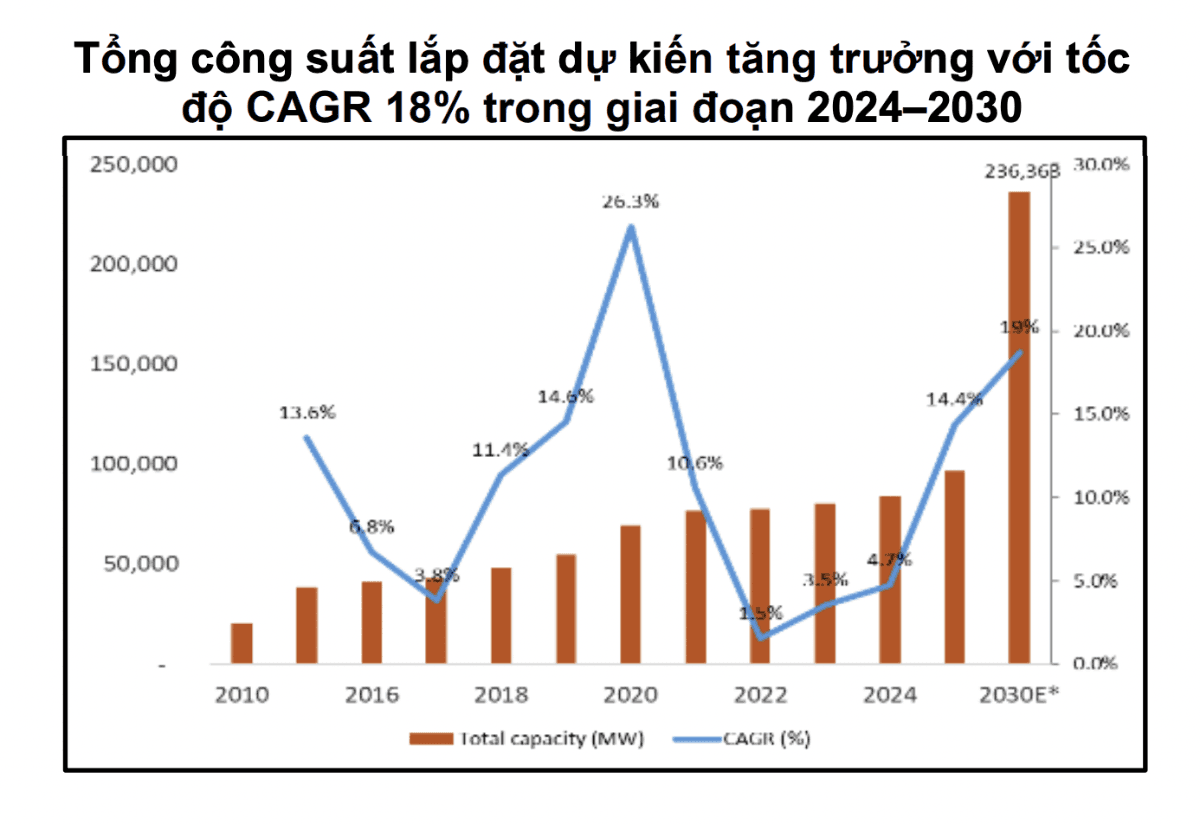
Yuanta Securities has issued an updated outlook for electricity sector stocks, maintaining a positive long-term view on green energy companies. The revised Electricity Planning VIII (Power Plan VIII) places renewed emphasis on renewable energy, supported by large investments already anticipated.
Electricity consumption in 2025 reached 288 billion kWh, up 4.9% year-on-year. In Q1 2025 (latest available data), Vietnam became more dependent on coal-fired thermal power due to a decline in natural gas supply. Coal-fired power accounted for 54.3% of electricity consumption; gas turbines 6.6%; solar 9%; wind 4%; hydro 23.4%; and imported electricity 2.1% of total system generation.
Yuanta said Power Plan VIII sets an electricity production compound annual growth rate (CAGR) of +12.4% for 2024–2030 to support a GDP growth target of +10% over the same period. Decision 1509/QD-BCT outlines a large investment plan for 2026–2030, including $118 billion (about $23.6 billion per year) for power generation and $18 billion (about $3.6 billion per year) for the grid.
The broker expects this to benefit electrical construction companies and green energy providers.
Yuanta noted that coal-fired power faces near-term challenges as input prices rise sharply. The conflict in Iran has driven fuel oil (FO) prices to double to about $700/ton within days. For thermal plants, input gas prices could also rise due to a pricing formula set at 46% of the FO price plus freight. In parallel, global coal prices have increased, lifting input costs for coal-fired plants.
Under power purchase agreements (PPAs), Yuanta said power prices from coal-fired plants will eventually rise accordingly. Typically, 80% of output is sold under a contract price mechanism (cost plus margin), while 20% is sold on the market. However, gas-fired plants may become less attractive to the sole buyer EVN once input costs are reflected in production costs.
Yuanta indicated that wind and solar currently appear more attractive than coal-fired generation, at least compared with POW’s plants. It cited 2025 average selling prices for NT2 at VND 2,438/kWh and NT1 at VND 2,546/kWh. These levels were recorded before the Gulf crisis and were already higher than the purchase prices for solar and wind power.
For coal-fired power, the average selling price (GBBQ) at Vung Ang was VND 1,900/kWh. The cap price for wind is currently around VND 1,800–2,000/kWh, while solar prices are below VND 2,000/kWh, ranging from 1,149 to 1,876 VND/kWh.
For Solar FIT 2 projects operating commercially before 2021, prices range from 7.09 US cents (1,900 VND)/kWh for ground-mounted solar to 8.38 US cents (2,220 VND)/kWh for rooftop solar. Based on these comparisons, Yuanta reiterated its positive long-term view for green energy companies.
Yuanta said the revised Power Plan VIII clearly emphasizes renewables with large planned investments. Potential beneficiaries include electrical EPC PC1 and energy developers REE, HDG, and GEG.
PC1 is described as the market leader in electrical EPC. Its EPC backlog reached VND 8,250 billion (+19.7% year-on-year) in December 2025, and Yuanta expects it could remain high due to energy demand and the government’s new power plan.
PC1 also has three wind farms with total capacity of 144 MW under FIT 1, with the FIT 1 price at 8.5 US cents (the highest price). Yuanta expects PC1 to implement two hydropower projects in the near future: Bao Lac A (30 MW) and Thuong Ha (13 MW). As a result, it expects PC1’s hydroelectric capacity to increase by +25.4% by Q4/2026.
Yuanta added that PC1’s valuation may also improve alongside expectations for return on equity (ROE) expansion in 2025–2026E.
Overall, Yuanta characterized the current market environment as favorable for long-term investors, citing “many good stocks and very low prices.”
Premium gym chains are entering a “golden era” that is ending or already in decline, as rising operating costs collide with shifting consumer preferences toward more flexible, community-based ways to exercise. Long-term memberships are shrinking, margins are pressured by higher rents and facility expenses, and competition from smaller, more personalized…