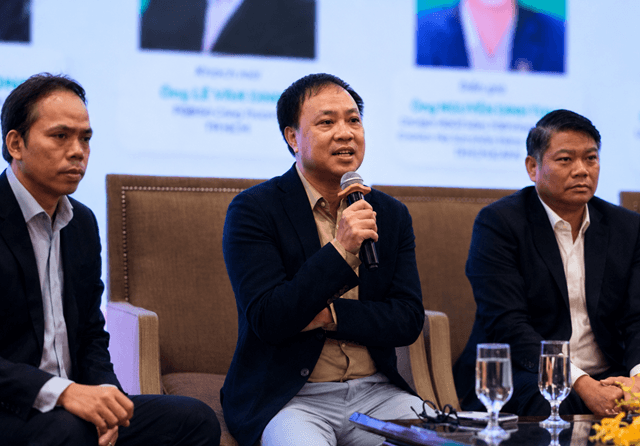
A month of logistics costs amounts to around 22 billion VND, while gross profit is about 41 billion VND, according to Phan Minh Thông, chairman of Phúc Sinh Group, who spoke at the HUBA Entrepreneur Café on July 4. “Even shipping charges alone accounted for as much as 17 billion VND,” Thông said.
For exporters, logistics are not limited to freight charges; goods must also go through domestic transport, warehousing, port handling, surcharges, and numerous procedures before reaching the market. Each added step reduces the remaining profit. Thông argued that if export goods are still mostly transported by truck to the port, enterprises will find it very hard to reduce costs. Vietnam has riverine advantages but has not exploited them effectively, while rail links connecting industrial zones to ports remain insufficient.
Another challenge is that domestic firms are heavily dependent on international shipping lines. When rates rise, containers are scarce or lines shift capacity to other routes, leaving exporters with few options.
Additionally, firms’ purchasing approaches contribute to higher costs. Each unit typically books space for a single shipment, limiting leverage in negotiations with carriers. By contrast, logistics companies that consolidate cargo from multiple customers can sign long-term contracts at lower rates. When demand is pooled and minimum volumes are committed, pricing can be shared among participants.
“In Vietnam, commitments are rather weak. We don’t want to commit to anything, but we want to buy at low prices,” Thông noted.
Beyond transport, exporters face costs from origin-tracing requirements and sustainability compliance. Markets such as Europe are tightening standards on sourcing areas, supply chains, and green production. These tasks require formal management systems, while many small and medium enterprises lack the resources to implement them themselves.
For the fresh fruit sector, the problem is even more acute because goods depend on storage time. A batch of export fruit must pass through multiple steps—from grove purchases to processing, packaging, irradiation, quarantine, and procedures before loading onto port or airport. Each change of transport mode, location, or paperwork waiting time increases costs. For fresh produce, waiting time also degrades quality faster. Some lots weighing tens of tons require purchases from hundreds of farmers, with enterprises managing transport and traceability documents required by importing countries. Rising costs of cold-chain transport add to pressure, with refrigerated container rental rates nearly tripled versus early May. To avoid missing shipments, many units invest in their own container fleets, though this is not their core business. Thông said this is a stopgap solution, and exporters should focus on products and markets rather than managing drivers, vehicles, and shipping schedules.
To address cost pressure, Thông proposed industry associations consolidate demand from many firms to procure logistics services at scale. When production volume is large enough, providers can offer stable pricing and be more competitive than individual firms negotiating a few containers per week.
From the provider side, Dang Thi Minh Phương, chair of the Ho Chi Minh City Logistics and Port Association (HLA), said costs rise not only due to international freight rates. Warehouse rents, surcharges, labor, and many domestic operating costs are rising. Driver costs for container handling have shifted sharply: previously, firms could hire drivers at around 25 million VND per month; from the start of the year to now, 45–50 million VND is still hard to find workers.
However, cost increases are not entirely market-driven. Many firms still perform nearly all logistics in-house—from vehicle purchase and warehouse rental to organizing transport. This approach fragments resources, resulting in underutilized fleets and warehouses and higher costs per shipment.
Phương proposed firms be bold about outsourcing non-core activities, using shared warehouses, shared fleets, and technology to manage flow. For exports, if capable, firms can progressively shift from selling FOB to CIF or DDP, meaning deeper involvement in transport, insurance, and delivery to the destination, rather than leaving all of these services to foreign partners.
Le Van Danh, deputy director of the Ho Chi Minh City Department of Industry and Trade, said logistics is one of the city’s five key economic sectors. For 2026–2030, HCMC aims to reduce logistics costs to 11–14% of GRDP through multi-modal transport development and better connectivity between production areas and ports.
After expanding its geographic scope, HCMC has new conditions to reorganize flows. Binh Duong is a production hub; Ba Ria-Vung Tau and Can Gio are port gateways for logistics. If these areas are better connected by road, water, and rail, the distance from factory to port could be shortened, reducing reliance on trucks. One project mentioned is the Bau Bang – Cai Mep – Thi Vai rail route connecting industrial zones with the port. The city is also studying other regional rail lines and improving inland waterways to share traffic with road.
Following input from businesses at the seminar, Danh said he would study building a logistics exchange to connect transport-demand units with service providers. Through this platform, orders could be consolidated at a larger scale, helping transport providers optimize operations and reduce costs for customers. At the same time, the city plans to develop specialized logistics centers for groups such as seafood, agricultural products, textiles and garments, wood, and steel, acknowledging that each sector has different storage, preservation, and transport needs requiring tailored infrastructure and organization.
Large infrastructure projects will take time to bear fruit. In the meantime, enterprises must review controllable costs. Loc, vice president of HLA, said firms cannot easily influence international freight rates or the strategies of global carriers. What can be done immediately is to review domestic logistics operations—from transport routes, warehouses, depots, ICDs, to post-port services. He added that business leaders should not assume logistics departments already operate efficiently; transport routes should be reviewed regularly, compared with new market options, and outsourcing considered if a partner can achieve lower costs.
According to participating businesses, reducing logistics costs is not only about infrastructure or policy. Even while awaiting rail, port, and logistics-center projects, changing how transportation is organized, strengthening linkages among firms, and more efficient use of existing logistics services are seen as the most feasible solutions to reduce costs and boost competitiveness.