•
•
•
•
•
•
•
•
•
•
•
•
•
•
•
•
•
•
•
•
•
•
•
•
•
•
•
•
•
•
•
•
•


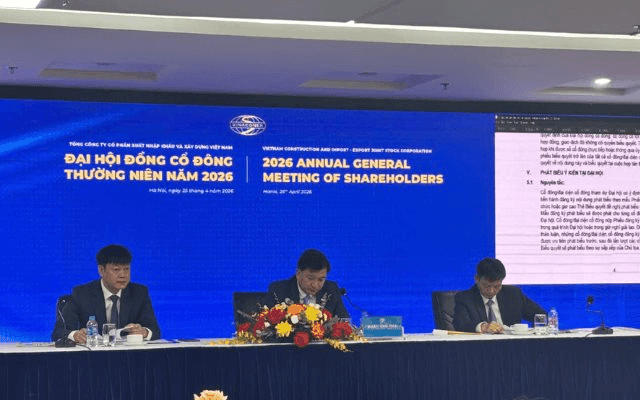
On April 25, Vinaconex Joint Stock Company – Vietnam Import-Export and Construction Corporation (stock code: VCG) held its 2026 annual general meeting of shareholders. The company reported strong 2025 results, while management discussed ongoing legal issues related to bid-rigging, progress on key projects, and a cautious outlook for 2026.
In 2025, Vinaconex’s consolidated revenue reached 19,868 billion VND, achieving 128% of the 2025 plan and equal to 151% of 2024. Consolidated after-tax profit rose to 3,865 billion VND, equivalent to 322% of the 2025 plan and 349% of 2024—its highest after-tax profit to date.
Management said bidding and project development remained a key growth pillar. The total value of contracts won exceeded 9,200 billion VND.
In the first quarter of 2026 (1Q2026), consolidated revenue was 3,708 billion VND and after-tax profit was 381 billion VND.
During the meeting, a shareholder asked how legal issues related to bid-rigging at the end of 2025 would affect 2025 results and the 2026 plan. CEO Nguyen Xuan Dong said the matter is still under investigation with no final conclusion, so the company cannot fully assess risks at this time.
For 2025 specifically, he said the impact is not significant because the event occurred late in the year and there is no basis to recognize effects in 2025. Any consequences, he added, would fall into the 2026 financial year, and the board has prepared a cautious plan for 2026.
“We aim to minimize negative impacts on operations; now is the time for staff and shareholders to unite to overcome the difficulties, preserve the brand, and restore stable operation,” he said.
For the Hoa Binh Boulevard project, infrastructure and supporting facilities are largely complete, with current revenue above 200 billion VND. However, higher interest rates have slowed the sales pace. Vinaconex said it is adding amenities to accelerate progress.
For the Mo Market project, 2025 revenue reached 1,100 billion VND from 123 lots. In 2026, about 540 billion VND (54 lots) has not yet been recognized. In Q1 2026, 300 billion VND was recognized, and management expects another 240 billion VND in Q2.
In Construction and Public Investment, the backlog stands at 16,753 billion VND, including about 10,900 billion VND from public investment projects and 5,771 billion VND from non-public investments.
Management noted that while public investment is being promoted, 2026 remains challenging for construction firms in general. Materials costs are high, and price adjustments may not keep pace. Site management costs, machinery, and daily material costs continue, while labor availability is tight as some large firms pay double or triple market rates. Management said average salaries are now around 25–30 million VND, while some firms are willing to pay 45–50 million VND.
Given these difficulties, Vinaconex said it is prioritizing key projects (including Long Thanh) and delaying others. The 2026 profit outlook for the construction segment is not high.
Deputy General Director Pham Thai Duong said Q1 2026 new contracts included two small projects: the Tu Lien Bridge road (over 110 billion VND) and the electricity portion of the Ha Giang – Tuyen Quang expressway (about 50 billion VND).
For 2026, the company’s plan for new contracts targets 4,000–6,000 billion VND for public investment and 2,000–3,000 billion VND for FDI projects.
Regarding the North–South high-speed rail project, Vinaconex said it is collaborating with Hanoi University of Construction to train 34 engineers for high-speed and urban rail.
The company also reported signing joint ventures and partnerships with foreign firms from China, Korea, and Taiwan, focusing on FDI or international-bid public investment projects.




Premium gym chains are entering a “golden era” that is ending or already in decline, as rising operating costs collide with shifting consumer preferences toward more flexible, community-based ways to exercise. Long-term memberships are shrinking, margins are pressured by higher rents and facility expenses, and competition from smaller, more personalized…




