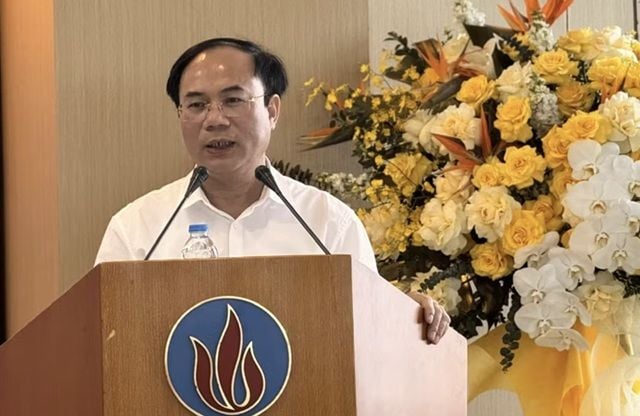
When will the Ministry of Construction divest its stake in Viglacera? Deputy Minister of Construction Nguyen Van Sinh affirmed that a 'timely' moment would be chosen to divest the state's stake in Viglacera after completing issues related to valuation and ensuring the efficiency and transparency of the state capital. At Viglacera’s 2026 annual general meeting of shareholders on April 25, 2026, Mr. Nguyen Van Sinh, the Deputy Minister, provided details on the roadmap for state divestment in this enterprise. According to the plan approved by the Prime Minister, Viglacera was expected to carry out state divestment in the 2024-2025 period. However, to date, this cannot be implemented. The government’s ownership in Viglacera remains at 38%. The deputy minister noted that Viglacera has grown rapidly in recent years in scale, scope of activities, and total assets. The company has broadened investments across multiple areas, including international projects, which has made valuing the company for divestment more complex. According to Mr. Sinh, Viglacera has proactively sought opinions from the ministries involved, especially the Ministry of Finance, on valuation methods to be used for the divestment. However, the valuation process has encountered many difficulties, while the requirement is to ensure rigor and avoid losses of state capital and assets. “Based on that, in February 2026, the Ministry of Construction reported to the Prime Minister on the entire process of implementation and the difficulties in the divestment work at Viglacera. The ministry proposed, at the moment, to suspend the divestment, to consider it in the 2026-2030 period, and to proceed with the divestment at an appropriate time,” Sinh said. Currently, the Ministry of Construction still holds more than 38% of the charter capital in Viglacera. Evaluating the company’s operations, Sinh noted that Viglacera is one of the leading state-owned construction conglomerates, with stable production efficiency and continuously rising assets and equity. Regarding this year’s plan, Viglacera’s CEO Nguyen Anh Tuan said the business environment has shown many abnormal factors compared with the plan. Geopolitical tensions have pushed
fuel prices higher, while fuel costs account for 20-40% of the cost of building materials, especially for products that require firing. In addition, tighter real estate credit and high interest rates have slowed many projects, reducing demand for building materials relative to expectations when planning. In real estate, Viglacera aims to focus on segments with real demand, particularly affordable housing. According to company leadership, mid-range and reasonably priced segments may account for 70-80% of market demand, which will be the strategic focus in the near term.