•
•
•
•
•
•
•
•
•
•
•
•
•
•
•
•
•
•
•
•
•
•
•
•
•
•
•
•
•
•
•
•
•
Vinhomes’ unrecorded backlog—reported at 186,400 billion VND at end-2025—has grown sharply, according to Vietcap’s updated assessment. The figure implies a 98% year-on-year increase and helps explain where the company’s large pipeline of contracted but not yet recognized revenue is coming from.
Vietcap estimates that 46% of Vinhomes’ end-2025 unrecorded backlog comes from sales of large plots. Another 40% is attributed to recognizing new sales, mainly from projects including Green Paradise, Ocean Park 2 and 3, Green City, and new launches at Làng Vân/Hải Vân Bay.
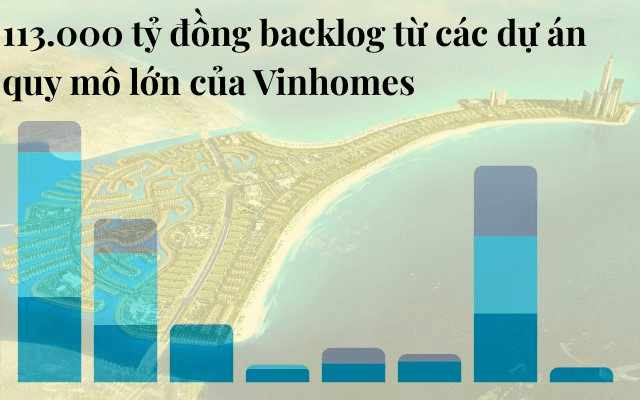
Vietcap also highlights that Vinhomes has seven large-scale projects currently under sale. If only these projects are counted, the unrecorded backlog would be about 113,000 billion VND.
Wonder City (Hanoi): Unrecorded sales of 43,100 billion VND. The project includes 2,300 low-rise and 600 high-rise units. To date, 2,200 low-rise and 600 high-rise units have been sold, leaving around 100 low-rise units unsold. Delivery is expected in 2026–2027.
Royal Island (Vu Yên, Hải Phòng): Unrecorded sales of 36,200 billion VND. With a total scale of up to 9,500 low-rise units, around 9,300 have been sold and about 200 remain unsold. Delivery is expected from 2024 to 2028.
Golden City: Contributes 16,300 billion VND to the unrecorded backlog. Of 6,100 low-rise units, Vinhomes has sold 3,100. Delivery is expected from 2025 to 2029.
Green City (Southern market): Unrecorded backlog of 11,600 billion VND. Vinhomes has sold 3,400 of 4,600 low-rise units, with delivery from 2025 to 2029.
Green Paradise (Cần Giờ, Ho Chi Minh City): Contributes 6,200 billion VND. The mega-project includes 22,600 low-rise units plus a high-rise subarea. It has sold 11,200 low-rise and 12,500 high-rise units, leaving about 11,400 low-rise units unsold. Delivery is expected from 2025 to 2042.
Vietcap notes that other large projects such as Ocean Park 2, Ocean Park 3, or Golden Avenue no longer contribute to backlog in the same way as the seven large-scale projects above.
The large unrecorded backlog is viewed as a solid base to sustain growth amid macro challenges. Vietcap projects that Vinhomes’ 2026 core real estate revenue will reach 157,000 billion VND, up 14% year on year.
Vietcap also expects that around 60% of this 2026 revenue will be converted directly from the 186,400 billion VND backlog accumulated by end-2025.
Vietcap forecasts total sales for 2026–2028 at 633,000 billion VND. Of this, about 47% is expected to come from ongoing projects and 53% from new projects, including Hai Van Bay, Ha Long Xanh and the International University City/IUT in 2026; Phuoc Vinh Tay and Tuyên Quang in 2027; and Quang Hanh and Ven Vinh Cam Ranh in 2028.
However, Vietcap notes risks that project delivery may be slower than expected. It also points to the possibility that prolonged geopolitical tensions could pressure policy operations of the SBV.
Vietcap expects Vinhomes to continue opening many new projects in 2026. It argues that Vinhomes is positioned to weather near-term challenges, including higher interest rates than in 2025, supported by its capability, proactive strategy, and strategic partnerships.
Vietcap adds that the portfolio may benefit from long-term infrastructure development potential. It says infrastructure work for planned sales projects such as Hai Van Bay and Ha Long Xanh is ongoing, and notes that the Hai Van Bay launch event occurred recently. Vietcap expects retail and bulk sales at new and existing projects to accelerate toward late 2026.
Coinbase has launched a High Yield USDC vault within its in-app DeFi lending offering, adding a second lending option that provides exposure to a wider range of collateral assets. The product is powered by Morpho infrastructure and uses vault allocations curated by Steakhouse Financial.