•
•
•
•
•
•
•
•
•
•
•
•
•
•
•
•
•
•
•
•
•
•
•
•
•
•
•
•
•
•
•
•
•


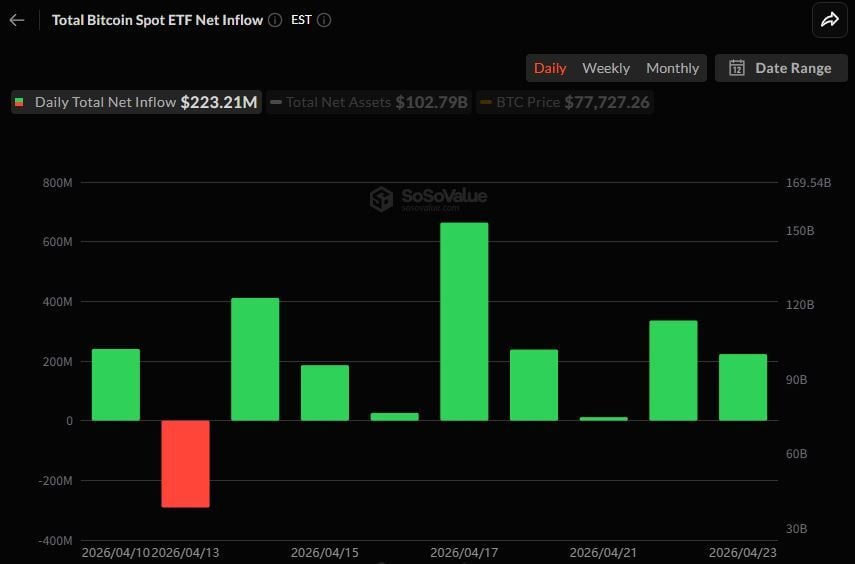
U.S. spot Bitcoin (BTC) exchange-traded funds extended their run of 'net inflows' for an eighth consecutive session on Wednesday, underscoring resilient institutional demand even as daily allocations cooled from the prior day’s pace. According to data compiled by SosoValue, U.S.-listed spot Bitcoin ETFs recorded $223.21 million in net inflows on April 23 (ET). The streak has held since April 14, signaling steady capital formation despite day-to-day volatility in flow volumes. Wednesday’s figure came in below April 22’s $335.82 million, but remained firmly positive, lifting cumulative net inflows to $58.55 billion. Flows were concentrated in a handful of products. BlackRock’s iShares Bitcoin Trust (IBIT) led with $167.49 million in net inflows, followed by ARK 21Shares Bitcoin ETF (ARKB) with $71.22 million. Morgan Stanley’s MSBT added $9.36 million, while Grayscale Bitcoin Mini Trust (BTC) drew $5.16 million. Offsetting part of the gains, Fidelity Wise Origin Bitcoin Fund (FBTC) posted $16.93 million in net outflows, joined by Bitwise Bitcoin ETF (BITB) with $7.60 million out and VanEck Bitcoin Trust (HODL) with $5.50 million out. Other funds were essentially flat on the day. Trading activity remained elevated, with total spot Bitcoin ETF turnover reaching $2.36 billion. IBIT dominated volumes at $1.77 billion, followed by FBTC at $246.44 million and Grayscale Bitcoin Trust (GBTC) at $97.43 million—an indication that liquidity continues to cluster in the largest and most actively traded vehicles. In terms of assets, the spot Bitcoin ETF complex held $102.79 billion in total net assets, representing roughly 6.59% of Bitcoin’s total market capitalization. By fund size, IBIT remained the clear leader with $63.14 billion in net assets, followed by FBTC at $14.61 billion and GBTC at $11.80 billion. The persistence of inflows suggests that 'institutional allocation' to Bitcoin via regulated ETF wrappers remains intact, even as investors rotate between issuers and products. If the inflow streak continues, market participants are likely to interpret it as a stabilizing demand signal amid shifting macro expectations and ongoing positioning in broader risk markets. Article Summary by TokenPost.ai Market Interpretation - Inflows remain resilient: U.S. spot Bitcoin ETFs posted $223.21M net inflows on Apr 23, extending the streak to 8 consecutive sessions (since Apr 14), reinforcing the narrative of ongoing institutional participation. - Cooling but still constructive: Daily inflows slowed versus Apr 22 ($335.82M → $223.21M), suggesting demand is steady but not accelerating—more consistent with measured allocation than FOMO-driven buying. - Concentration risk in leaders: Inflows were heavily skewed to IBIT (+$167.49M) and ARKB (+$71.22M), implying that market sentiment is being expressed through the most trusted/accessible vehicles rather than evenly across issuers. - Rotation within the complex: Outflows in FBTC (-$16.93M), BITB (-$7.60M), and HODL (-$5.50M) indicate issuer rotation (fees, liquidity, tracking, platform availability) rather than broad risk-off behavior. - Liquidity clusters in the biggest funds: Total turnover was $2.36B, led by IBIT ($1.77B); trading activity staying high supports tighter spreads and easier execution, which can further reinforce institutional usage. - Material footprint vs. BTC market: Total ETF net assets reached $102.79B, about 6.59% of Bitcoin’s market cap—large enough to influence short-term price dynamics during flow surges or drawdowns. Strategic Points - Watch the streak as a sentiment gauge: Continued positive daily flows may be read by traders as a stabilizing demand signal amid macro uncertainty; a break in the streak could shift interpretation toward caution. - Track “who leads” more than “how much”: Persistent dominance of IBIT (both flows and volume) suggests the market’s marginal buyer prefers deep liquidity and operational familiarity—useful for timing and execution strategies. - Net inflow ≠ universal inflow: Mixed fund-level flows imply that investors may be optimizing fee/liquidity exposure rather than changing their overall Bitcoin view; fund selection factors can drive flows independent of BTC direction. - Liquidity signals tradability: High turnover (especially in IBIT/FBTC/GBTC) can support more efficient hedging and tighter execution for institutions, potentially reinforcing the ETF wrapper as the preferred access point. - AUM concentration matters: With IBIT at $63.14B versus FBTC $14.61B and GBTC $11.80B, price impact from creations/redemptions may be more sensitive to flows in the largest products. - Confirm with cross-checks: For stronger conviction, pair ETF flow trends with BTC spot/derivatives metrics (basis, funding, realized volatility) to distinguish allocation from short-term positioning. Glossary - Spot Bitcoin ETF: An exchange-traded fund designed to track Bitcoin’s spot price by holding actual BTC (or closely linked spot exposure) rather than futures. - Net inflow / net outflow: The net value of new money entering or leaving an ETF in a day, typically driven by share creations/redemptions. - Turnover (trading volume): The total dollar value traded for ETF shares over a period; higher turnover often implies better liquidity. - Net assets (AUM): The total value of assets held by the ETF complex or a specific fund; often used to assess scale and market influence. - Institutional allocation: Portfolio positioning by professional investors (funds, RIAs, corporations) typically characterized by methodical sizing and regulated access vehicles. - Issuer rotation: Shifting exposure between ETFs that track the same underlying asset, often due to fees, liquidity, brand trust, custody, or platform access. - ETF wrapper: The regulated fund structure that allows investors to gain exposure via standard brokerage accounts without directly custodying Bitcoin.








Premium gym chains are entering a “golden era” that is ending or already in decline, as rising operating costs collide with shifting consumer preferences toward more flexible, community-based ways to exercise. Long-term memberships are shrinking, margins are pressured by higher rents and facility expenses, and competition from smaller, more personalized…