•
•
•
•
•
•
•
•
•
•
•
•
•
•
•
•
•
•
•
•
•
•
•
•
•
•
•
•
•
•
•
•
•


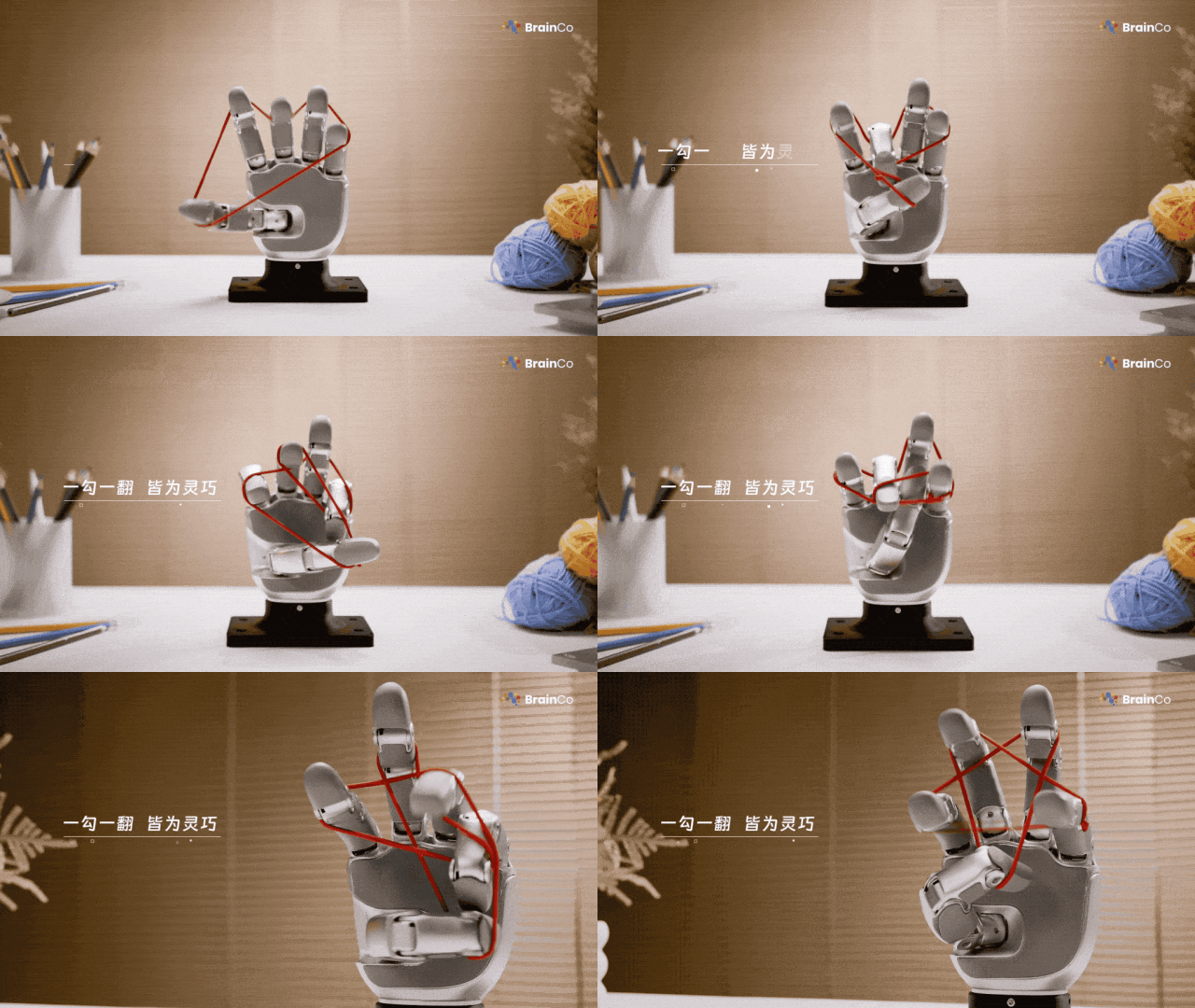
BrainCo has unveiled the agile robotic hand Revo 3, positioning the company’s technology beyond neural interfaces and medical hands toward embodied intelligence hardware. In a market often focused on simple grippers, Revo 3’s promotional demonstrations highlighted tasks including pulling strings to form shapes such as a five-point star, cutting paper, coordinating both hands to twist a Rubik’s cube, and spinning a fidget spinner.
The product is developed by BrainCo, one of the six “dragon heads” in Hangzhou. The company is known for neural interface technology and for producing prosthetic hands for people with disabilities. Revo 3 is presented as part of a shift from restoring hand function to equipping robots with dexterous, human-like capabilities.
BrainCo describes Revo 3 as a comprehensively developed hand with no weak points, emphasizing a balanced approach across degrees of freedom, actuation, sensing, durability, and price rather than maximizing a single specification.
Key technical specifications include:
BrainCo says it arrived at 21 DOF through a series of system tests. It reports that when DOF increases from 11 to 20, performance improves only slowly, while increasing from 20 to 21 produces a substantial jump. The company links this improvement to enabling robots to perform complex actions such as rolling a ball or solving a Rubik’s cube stably.
The company also highlights backdriven capability as important for reducing discrepancies between simulation and real-world performance. It notes that joints with high stiffness can cause algorithms to fail in real environments, and that Revo 3’s direct-drive and backdriven design allows each joint to respond to applied forces.
Revo 3’s perception system is designed to address limitations in robotic weight sensing. BrainCo states that the hand combines a palm-wide tactile array to recognize contours, softness/hardness, and slip direction, along with fingertip vision sensors used as “eyes” to calibrate precisely at submillimeter levels.
Economically, Revo 3 is positioned as a cost-effective product with high durability. BrainCo says it inherits stringent standards from its dexterous-hand line developed over seven years for prosthetic use.
The hand has been vetted by leading organizations and added to partnership rosters, including Unitree, Leju, AgileX, the Beijing Center for Robotic Innovation (or LimX Dynamics).
BrainCo says it will open-source the embodied algorithm. It also states that users can operate the device within half a day and that Revo 3 supports compatibility with MuJoCo, Isaac Gym, and NVIDIA Omniverse.
The launch follows BrainCo’s recent funding activity. In January, the company raised 2 billion yuan led by IDG Capital and Walden International, described as the largest single-raise in this space globally (apart from Neuralink). BrainCo also references rumors of a Hong Kong IPO and says it maintains a strong position.
Looking ahead, BrainCo plans to launch three to five products in the future to cover more segments. The company frames its long-term direction around brain-computer interface capabilities and aims for an integrated “carbon and silicon” infrastructure to enable brain-controlled automation of robots.







Premium gym chains are entering a “golden era” that is ending or already in decline, as rising operating costs collide with shifting consumer preferences toward more flexible, community-based ways to exercise. Long-term memberships are shrinking, margins are pressured by higher rents and facility expenses, and competition from smaller, more personalized…