•
•
•
•
•
•
•
•
•
•
•
•
•
•
•
•
•
•
•
•
•
•
•
•
•
•
•
•
•
•
•
•
•


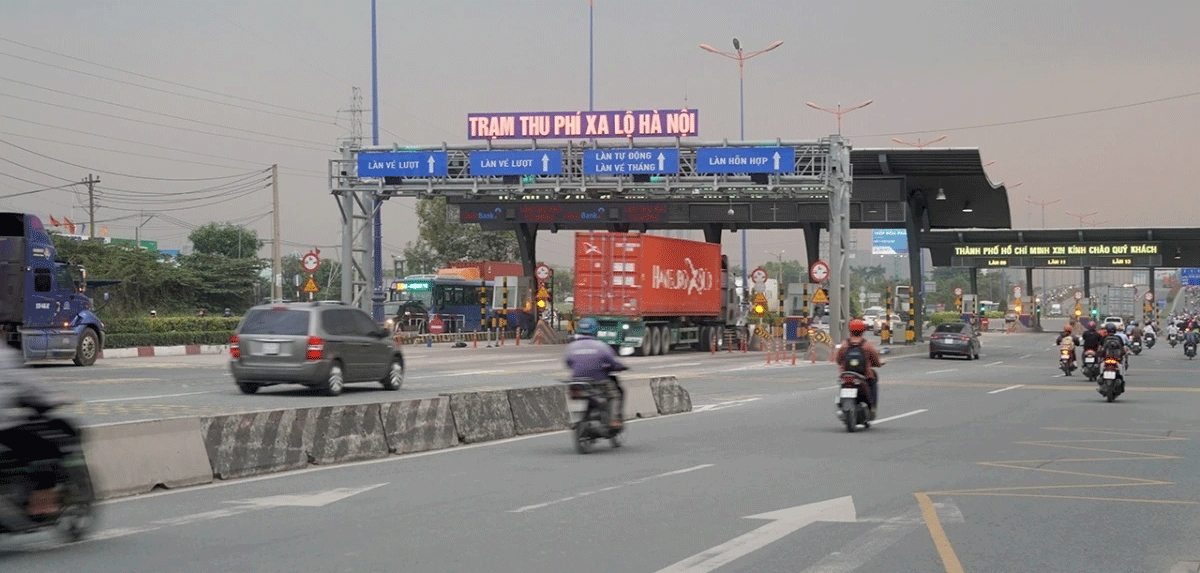
CII and HFIC have been assigned by the Ho Chi Minh City People’s Committee to prepare a feasibility study for the BOT Võ Nguyên Giáp, Xa Lộ Hà Nội and National Highway 1 project, to be implemented through a public-private partnership (PPP) under the name Xa Lo Ha Noi 2. Specifically, on March 26, 2026, the city’s People Committee approved the formation of a joint venture between CII and the Ho Chi Minh City State Capital Investment Fund (HFIC) to develop the feasibility study for the project aimed at enhancing throughput on Vo Nguyen Giap, Xa Lo Ha Noi and National Highway 1 from the Sai Gon Bridge to the Tan Vạn junction under PPP. Xa Lo Ha Noi 2 has an estimated total investment of about VND 3,500 billion, with a scope that upgrades five key intersections along a 15.4 km corridor. CII’s leadership said the Xa Lo Ha Noi 2 project is expected to relieve traffic bottlenecks at grade-separated intersections that regularly cause congestion during peak hours. In addition, Xa Lo Ha Noi 2 is significant for strengthening connectivity between the city’s eastern areas and major industrial-service hubs in Dong Nai, Binh Duong, and Ba Ria–Vung Tau, and for expanding future access to Long Thanh International Airport. On this strategic corridor, improving capacity to absorb, distribute, and regulate traffic on Vo Nguyen Giap – Xa Lo Ha Noi – National Highway 1 not only has transport infrastructure implications but also supports emergency response, rescue, and defense requirements, in tandem with the Ho Chi Minh City–Long Thanh–Dau Giay expressway. According to CII, being assigned this project together with a partner reinforces the company’s capabilities, experience, and reputation in transport infrastructure investment and development. To date, besides seven income-generating projects already in operation with steady growth, the list of new projects that CII is prioritizing resources to invest in and that authorities have tasked the company to lead as a proposer amounts to a total of up to VND 59,725 billion. Reportedly, net profit after tax (PAT) for 2025 per audited consolidated financial statements reached VND 367.6 billion, down VND 9.4 billion (approximately 2.5%) from the pre-audit figure. According to CII’s explanation, gross profit from operations remained stable compared with 2024, reaching VND 1,662 billion in 2025 and VND 1,664 billion in 2024, reflecting the core operating performance of projects and main business activities. The 2025 PAT movement versus the previous year (2024 PAT of VND 620.7 billion) mainly stems from 2024 when the company recognized VND 430 billion from fair-value gains on its investment in Nam Bay Bay Investment Joint Stock Company (NBB) when it gained control. Related to this business combination, during the period the company completed the fair-value assessment for the subsidiary as of the acquisition date. Under Vietnamese Accounting Standards, the company applied retrospective accounting for this business combination, as disclosed in Note V.15. In addition, the company continued to increase its ownership stake from 63.05% to 79.79%, with the difference between the fair-value increase and the carrying value of net assets recognized directly into retained earnings in accordance with the applicable standards.





Premium gym chains are entering a “golden era” that is ending or already in decline, as rising operating costs collide with shifting consumer preferences toward more flexible, community-based ways to exercise. Long-term memberships are shrinking, margins are pressured by higher rents and facility expenses, and competition from smaller, more personalized…




