•
•
•
•
•
•
•
•
•
•
•
•
•
•
•
•
•
•
•
•
•
•
•
•
•
•
•
•
•
•
•
•
•
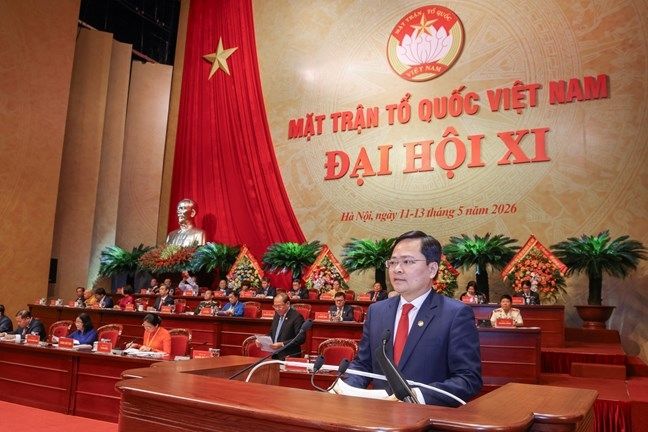
On May 13, at the closing session of the 11th National Congress of the Vietnam Fatherland Front for the 2026–2031 term, Mr. Nguyen Anh Tuan—member of the Party Central Committee, Vice Chairman of the Central Committee of the Vietnam Fatherland Front, and President of the Vietnam General Confederation of Labor—presented a consolidated report summarizing comments, discussions, and deliberations at the Congress.
Under the theme “Unity - Democracy - Innovation - Creativity - Development,” the Congress received 106 submissions. Of these, 40 were from the Fatherland Front committees of provinces and cities, 48 from member organizations, and 18 from individuals representing various social strata and the Vietnamese community abroad.
The report said the submissions were carefully prepared, of high quality, and drew many ideas from practical experience, offering concrete recommendations and solutions to renew the Front’s content and methods in the new situation.
The Congress recorded 81 statements, including 8 made directly in the hall; 51 delivered in person; and 22 submitted in writing at five discussion centers. Delegates demonstrated a democratic, frank, and responsible spirit, contributing ideas to help complete the Congress draft documents.
Many opinions expressed satisfaction with the country’s achievements after nearly 40 years of renewal, affirming that the great national unity bloc remains a vital resource for overall development.
Delegates also highlighted the Front’s role in the previous term, noting that it had thoroughly embraced the principle “People are the root.” They said the Front should increasingly perform its role as representative and defender of the people’s lawful and legitimate rights and interests.
Recommendations included continuing to play a leading political role in building the all-people national unity bloc, focusing on mobilizing and gathering ethnic minorities and adherents, and promoting the role of trusted people and exemplary individuals within communities.
Notably, many delegates emphasized the need to strengthen the Front’s supervisory and critical role in society. They called for shifting from event-based oversight to issue-based oversight, intensifying follow-up to ensure recommendations are fully resolved after supervision, and publicly disclosing results to enable citizen oversight.
There was also emphasis on completing mechanisms and regulations on responsibility and sanctions for agencies and organizations involved in absorbing, processing, and responding to Front recommendations, alongside ensuring transparency of resolution results for public monitoring.
Delegates proposed mobilizing experts, scientists, and experienced managers to participate in supervision and social criticism, and strengthening the role of advisory councils within the Front system.
The Congress proposed accelerating comprehensive digital transformation in the Front’s work. This includes building a “Digital Front,” developing digital interaction channels to promptly receive citizen feedback, and completing a shared digital platform across the system to ensure data interoperability and support leadership, governance, supervision, and social critique.
Delegates also suggested establishing and effectively utilizing a “Community Digital Technology Team,” described as a network of digital volunteers at the grassroots, and investing in technology infrastructure, equipment, and targeted training for Front cadres at all levels.
Some opinions urged continued promotion of the involvement of overseas Vietnamese and diplomacy with the Vietnamese diaspora. Recommendations included improving information to help localities connect, mobilize, and leverage diaspora resources for national development, and enhancing coordination mechanisms across the Front system.
At the closing session, the Presidium said it would fully incorporate all opinions and assign the Central Committee of the Vietnam Fatherland Front for the XI term to study, supplement, and finalize the Congress documents, and implement them in the next term.
The crypto bear market remained in force on Wednesday, with bitcoin slipping back toward the $60,000 area. Sharp pullbacks in gold and oil also weighed on the 2025 “debasement trade,” which had supported hard assets amid concerns about government debt and fiat currencies. Meanwhile, tech—particularly the AI boom—continued…