•
•
•
•
•
•
•
•
•
•
•
•
•
•
•
•
•
•
•
•
•
•
•
•
•
•
•
•
•
•
•
•
•


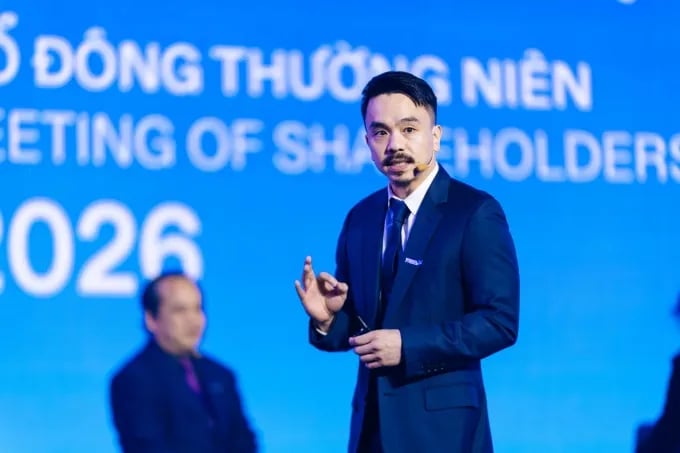
CEO Danny Le said Masan Group’s stock (MSN) is trading about 60% below its intrinsic value, arguing that the market has not yet fully reflected the potential of two key segments—meat and retail—within the broader Masan ecosystem.
At the company’s annual meeting, the heads of Masan’s business units presented their areas in a format that differed from prior years, when each unit presented separately. Chairman of the Board Nguyen Dang Quang opened the session, underscoring that Masan’s business lines will be more tightly connected.
In his remarks, Danny Le said the undervaluation is roughly 60% versus intrinsic value. He attributed the gap to management “has not fully described the journey and consumer-service strategy of the entire Masan ecosystem.”
Masan’s main segments include consumer products manufacturing (Masan Consumer - MCH), modern retail (WinCommerce - WCM), meat production (Masan Meatlife - MML), and mining (Masan High-Tech Materials - MSR). The group also owns the Phuc Long tea and coffee chain.
During the Q&A, a shareholder asked why the stock price has not grown. Danny Le said the market has been valuing MSN mainly through MCH and MSR, without fully reflecting MML, WCM, and Phuc Long. He said the group will focus on strengthening the model that connects all business units more tightly so the market can better understand and reflect the group’s full potential.
On cash flow, Le noted that after acquiring WinCommerce, the group incurred roughly $150 million in losses. He said the group’s cash flow in 2020 was about $80 million.
He also addressed concerns about whether Masan can turn around the retail system, which has faced problems. Le asserted that “this year” there is a high likelihood the group can ramp cash flow sevenfold, to more than $500 million.
Le said Masan’s model is not about building separate businesses, but about a unified strategy to maximize synergies across an end-to-end consumer retail value chain. He compared the approach to Steve Jobs’ integration of handset, internet, and music in the iPhone, calling it a “consumer operating system.”
On cash generation, he said that by the end of 2025 the group is targeting $500 million of operating cash flow, while CAPEX is not high. He said this would help reduce debt on the balance sheet.
Le cited that net debt/EBITDA has fallen to 2.8x, below the company’s target of 3x.
Le also responded to investor concerns about roughly $400 million in debt at Masan High-Tech Materials. He said that with tungsten priced at $3,000 per MTU, even if prices fall by half in two years, the company would still be debt-free.
“We believe we can manage the balance sheet very well and reach the healthiest state in the last five years,” he said.

Premium gym chains are entering a “golden era” that is ending or already in decline, as rising operating costs collide with shifting consumer preferences toward more flexible, community-based ways to exercise. Long-term memberships are shrinking, margins are pressured by higher rents and facility expenses, and competition from smaller, more personalized…