•
•
•
•
•
•
•
•
•
•
•
•
•
•
•
•
•
•
•
•
•
•
•
•
•
•
•
•
•
•
•
•
•


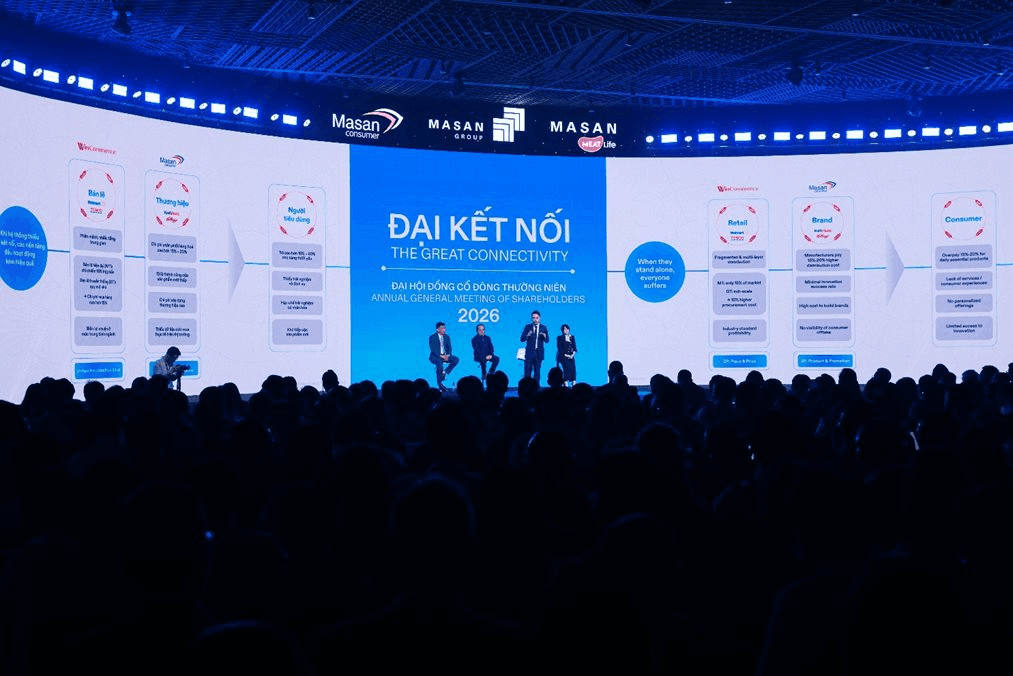
Masan Group Joint Stock Company (HOSE: MSN, “Masan” or “the Company”), together with its subsidiaries Masan Consumer (HOSE: MCH) and Masan MEATLife (HNX-UPCoM: MML), held its 2026 Annual General Meeting of Shareholders (AGM) under the theme “The Great Connectivity.”
The AGM theme “The Great Connectivity” was presented as a strategic milestone in Masan’s transformation toward building Vietnam’s Consumer Operating System (cOS). The company said Vietnam’s consumer-retail market has long been fragmented, with retail, brands and technology not cohesively connected, contributing to inefficiencies in the value chain and higher costs for essential products.
Following restructuring, WinCommerce—the operator of WinMart and WinMart+/WiN—has entered a new development phase, with operating results improving and investment and operating costs per store falling by approximately 30% versus 2020. WinCommerce moved from a loss of about VND 3,700 billion in 2019 to a target of VND 1,000 billion in net profit in 2026.
On this foundation, WinCommerce is accelerating retail infrastructure expansion, aiming for roughly 6,100 stores by the end of 2026. The company said the expansion will focus on rural areas, which account for about 70% of new store openings. Masan noted that modern retail currently accounts for about 14% of the market, and that the WinMart/WinMart+/WiN network is operating at about half of the country’s administrative units (1,300/3,250 communes/wards).
Masan targets modern retail market share above 20% by 2030, planning to open at least 1,500 new stores annually and aiming for a nationwide footprint of 13,000 stores. The company also cited a payback period under 3 years and an estimated ~40% return on investment for the modern retail model.
“Đại Kết Nối – The Great Connectivity” was also described as extending beyond Masan’s store network to connect and empower about 1 million traditional retail shops nationwide.
Under the Retail Supreme platform, Masan said it has shifted from a traditional wholesale-based distribution model to a direct-distribution model using digital tools and localized management. After a pilot in Ca Mau in 2024, the sales team now manages its territory to ensure Masan brands are present at nearly every point of sale.
Masan reported that the direct-served store network has expanded to 500,000 outlets (2.3x versus the level before Retail Supreme). It said average products per order increased to 5.5 SKUs, and 50,000 stores have been standardized for display to improve brand visibility and accelerate sales.
By the end of 2026, Masan targets expanding the network to 1 million points, including on-site consumer channels, with the average order size reaching 7 products. The company said each additional product in an order could add around VND 370 billion in monthly revenue.
In addition, Masan is expanding the WIN+ model—an integrated retail approach combining traditional GT and modern MT channels—to empower 70,000 GT partner stores, aiming for ~90% market coverage.
Masan said the brand strategy is intended to complement the retail platform by building consumer trust. The company aims to develop 16 Mega Brands for Masan Consumer (MCH), 3 Mega Brands for Masan MEATLife (MML), and 25–50 Mega House Brands for WinCommerce (WCM), targeting about 30% of total Vietnamese consumer spend.
Masan cited the fish sauce branding story—moving from unbranded to branded—as a model it expects to replicate across other categories.
It said branded meat products from MML currently represent about 2% of the meat market. Through a unified distribution platform with roughly 13,000 WinMart/WinMart+ outlets and over 70,000 WIN+ stores, Masan said MML has the potential to accelerate brand growth more efficiently than traditional models.
MML is also expanding from fresh meat into marinated and processed meat products to meet broader nutrition needs and consumption occasions, with the objective of making branded meat an everyday essential for Vietnamese consumers.
Masan attributed its growth capability to the digital platform underpinning cOS, with WinX at the center of connecting brands, retailers and consumers. The company said WinX has reached 15 million members and aims for 50 million in the near future. It said millions of daily transactions across the ecosystem generate continuous data on real consumer purchasing behavior.
Masan described Digital 4P as the consumer operating system connecting Brand–Retailer–Consumer through data and technology. It said Digital 4P optimizes the system in real time around four core elements:
Supporting Digital 4P is Supra, described as the supply chain backbone that applies technology to oversee end-to-end goods flow. Masan said Supra uses machine learning and automation to forecast demand and automate replenishment.
Masan said the deployment of cOS is expected to deliver superior financial results and sustainable value. For 2026, it set targets including:
Through the One Masan Operating Platform, Masan said it expects to generate USD 500 million of cash flow in 2026 and target USD 1 billion by 2030. The company also reported that in Q1 2026, Masan’s revenue and NPAT Pre-MI grew by 27.1% and 2.0x year-on-year, respectively.
Masan said growth was led by improvements across subsidiaries, with WCM profits up 3.5x, MCH up 11.5%, MML up 66.3%, and PLH up 80.8%. Masan Group CEO Danny Le said “The Great Connectivity” is not only a business strategy but a long-term commitment to Vietnam, adding that connecting the ecosystem’s pillars enables value creation and sharing for consumers, employees and shareholders.
Masan Group said it is committed to delivering superior products and services to 100 million people in Vietnam and around the world, helping them save on daily essentials. The group said it advances productivity through innovations, technology, strong brands and opportunities tied to everyday life, with subsidiaries and associates spanning consumer goods, branded meat, retail, F&B, financial services, telecommunications, and value-added industrial materials.

Premium gym chains are entering a “golden era” that is ending or already in decline, as rising operating costs collide with shifting consumer preferences toward more flexible, community-based ways to exercise. Long-term memberships are shrinking, margins are pressured by higher rents and facility expenses, and competition from smaller, more personalized…