•
•
•
•
•
•
•
•
•
•
•
•
•
•
•
•
•
•
•
•
•
•
•
•
•
•
•
•
•
•
•
•
•


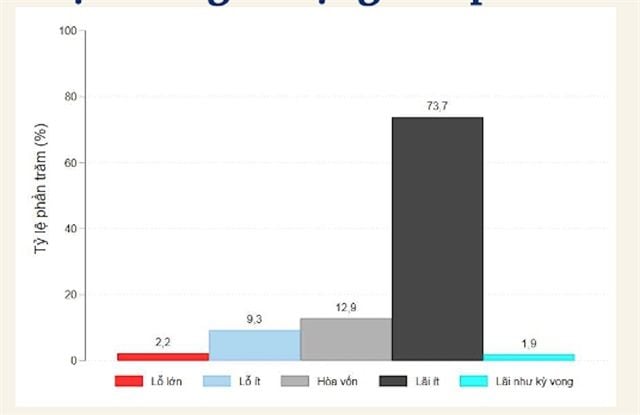
Most household businesses earn little profit, typically enough to sustain operations. A survey by the Viet Nam Chamber of Commerce and Industry (VCCI) found that 73.7% of household businesses reported only “low profits” in 2025, while more than 81% experienced revenue declines. With regulatory compliance burdens rising, most households chose to maintain or shrink their scale, and very few planned to expand.
On April 23, the Viet Nam Chamber of Commerce and Industry (VCCI) held a panel titled “Results of the Household Business Survey 2026.” The survey was conducted from February to April 2026 among more than 1,000 active household businesses across 34 provinces and cities. VCCI Deputy General Secretary Dau Anh Tuan said: “The current picture is not very optimistic, but it is very real.”
The results show that 73.7% of household businesses reported “low profits” in 2025. More than 81% reported revenue declines, 75% reported fewer customers, and only 1.9% said profits met expectations. The findings suggest that many household businesses operate with very thin margins, focused on staying afloat rather than building reserves against future shocks.
Weak business health has translated into a defensive approach. In the next two years, 60.8% of households expect to maintain their current scale, 33% plan to shrink, and 1.8% intend to expand. Overall, the dominant state for the sector is no longer growth, but maintaining existence.
Legal compliance difficulties were identified as the biggest pressure group, exceeding concerns related to costs or demand. Specifically, 73.3% of households said legal issues significantly affect operations.
Operational challenges tied to compliance were also prominent:
Time spent complying with regulations was viewed as the most burdensome aspect, with up to 73% rating the impact as large or very large. The compliance burden is therefore not only financial, but also an opportunity cost in terms of time, effort, and psychological stress for business owners.
The survey also found that the compliance burden does not decrease as businesses grow; it tends to rise with size. As household businesses expand, they face more complex accounting systems, heavier tax procedures, and higher payroll and technology costs—factors that can reduce incentives to invest and grow.
Only 15.6% of households intend to move up to a formal business within two years. Most remain hesitant due to concerns about more complex tax procedures, tougher accounting rules, higher social insurance costs, and higher risk of audits.
However, the survey noted a positive link between knowledge and willingness to transition: households that understand tax and accounting policies were significantly more willing to move, suggesting that knowing the “rules of the game” helps them assess costs and benefits rather than focusing only on risks.
VCCI’s research group said the household business sector remains a pillar of the family economy and a cushion for social welfare, but its health is weakening, profits are thin, and the mindset is increasingly defensive. The main trend for the coming years is expected to be maintaining or shrinking, while intentions to transition or expand remain very low.
Experts said the bottlenecks are not only weak demand or rising input costs, but also a mismatch between increasingly complex management requirements and the compliance capacity of a sector dominated by micro units. When regulatory difficulties become the biggest pressure and tax and accounting tasks act as barriers, reforming the business environment should focus on easing compliance rather than tightening regulation.
The panel emphasized that reforms should move toward “easier compliance,” including redesigning rules to be simple, easy to understand, and suited to household business realities. It also highlighted the role of practical tools such as simple accounting software, clear filing guidance, and local advisory systems.
Policy support, according to the findings, should target vulnerable groups while enabling those with growth potential to access resources and transition to new models. For transitions to formal business, mechanisms to reduce actual costs—such as financial incentives and tax support in the early stage—should be paired with an appropriate timetable of obligations to avoid shocks for new entrants.







Premium gym chains are entering a “golden era” that is ending or already in decline, as rising operating costs collide with shifting consumer preferences toward more flexible, community-based ways to exercise. Long-term memberships are shrinking, margins are pressured by higher rents and facility expenses, and competition from smaller, more personalized…