•
•
•
•
•
•
•
•
•
•
•
•
•
•
•
•
•
•
•
•
•
•
•
•
•
•
•
•
•
•
•
•
•


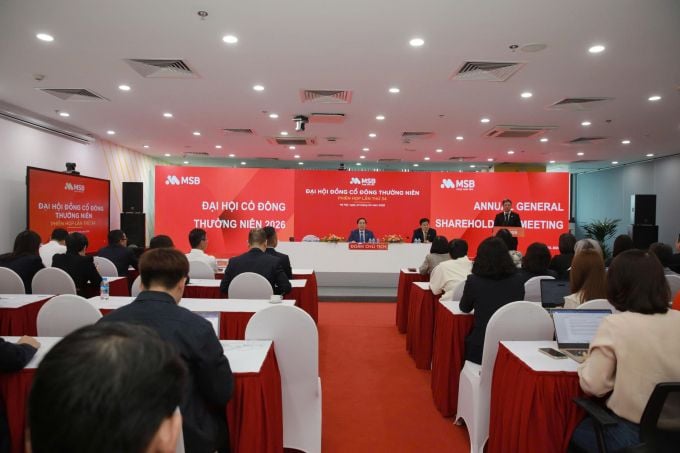
Vietnam Maritime Bank (MSB) has approved its 2026 business plan and a capital increase at its 2026 annual general meeting held on April 24, targeting pre-tax profit of 8 trillion dong, up 13% from last year. The bank also plans to issue an additional 624 million shares to raise charter capital to 37.44 trillion dong in 2026.
Under the approved plan, MSB expects total assets to reach 460 trillion dong in 2026, up 13% from 2025. Mobilization capital at the primary market and bond funding are projected to rise to 280 trillion dong, up 24% year-on-year.
Total outstanding credit is expected to increase by 18% to 244 trillion dong. The bank set a non-performing loan ratio target of below 3%, in line with regulatory requirements.
Shareholders approved increasing MSB’s charter capital to 37.44 trillion dong by issuing shares at a 20% rate from equity, equivalent to 624 million shares. The issuance is planned for implementation in 2026, subject to market conditions, and the shares are approved with no transfer restrictions.
Alongside strengthening its financial capacity, MSB submitted plans to contribute capital and acquire shares in a fund management company to convert the unit into a subsidiary, with the aim of expanding its investment product and asset management capabilities.
The bank also plans to convert TNEX Joint Stock Company from a specialized model to a diversified financial company, aiming to diversify products and improve business efficiency.
In 2025, TNEX reported total assets of 7,017 billion dong, up 84% from the previous year. Lending reached 3,805 billion dong, up 114%, while revenue rose to 699 billion dong, up 95%.
After the conversion, TNEX is expected to continue growing with targets including total assets up 20%, lending growth of over 100%, revenue up nearly 200%, and pre-tax profit rising by over 700%.
At the AGM, MSB’s leadership reported Q1 2026 consolidated business results. Pre-tax profit reached nearly 1,890 billion dong, up 16% year-on-year, fulfilling nearly 24% of the annual plan. Total assets were nearly 413 trillion dong.
Efficiency indicators remained stable, with ROA at 1.55%, ROE at 14.14%, and NIM at 3.23%. Cost control continued, with the CIR falling to 34.51%.
MSB reported a CASA ratio of 26.5%. Safety indicators were maintained within controlled levels, including non-performing debt at 1.88%, LDR at 62.91%, and the ratio of short-term capital used for mid- and long-term lending at 25.76%.
In the first half of 2026, MSB plans to complete and publish an ESG strategy with a 5-year roadmap. The bank expects to implement ESG initiatives across the system, integrating the three pillars—Environment, Social, and Governance—into its business strategy with specific measurement indicators.
Targets and KPIs will be allocated to each unit to align with the digital transformation roadmap and the green growth direction. A bank representative said the approach is intended to strengthen governance capabilities and gradually embed ESG into organizational culture, aiming for Net Zero and sustainable long-term value for shareholders, customers, and the community.
MSB’s leadership also emphasized that the directions and plans approved at the General Meeting of Shareholders will serve as a basis for the bank to continue delivering on its 2026 goals and maintain growth momentum.







Premium gym chains are entering a “golden era” that is ending or already in decline, as rising operating costs collide with shifting consumer preferences toward more flexible, community-based ways to exercise. Long-term memberships are shrinking, margins are pressured by higher rents and facility expenses, and competition from smaller, more personalized…