•
•
•
•
•
•
•
•
•
•
•
•
•
•
•
•
•
•
•
•
•
•
•
•
•
•
•
•
•
•
•
•
•


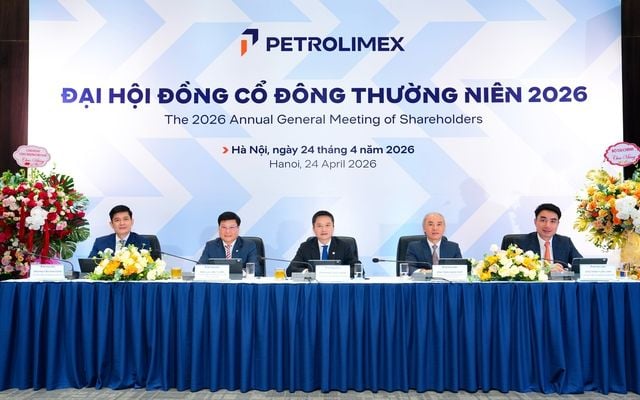
At the 2026 annual general meeting of shareholders on April 24, Petrolimex Group (PLX) said it expects a loss of 1,000 billion VND in the first quarter of 2026 from the gasoline and diesel segment, citing extreme volatility in global oil prices.
Petrolimex’s General Director Lưu Văn Tuyển said the group’s other business lines continue to perform well because oil-market price swings in the Middle East are beyond its control. He described days when the price of a barrel of oil moved by as much as 50 USD or fell by 20 USD—an outcome he said has not occurred before in history. He also cited that a barrel of oil reached 292 USD, and with surcharges and freight, could rise to 300–340 USD per barrel.
He added that the cost of imported cargo has increased sharply: a 40,000-ton oil shipment that previously cost about 25–26 million USD now costs about 85–87 million USD.
Chairman Phạm Văn Thanh said the group’s key strength in a market crisis is not market share or its network size, but its ability to manage infrastructure, coordinate operations, and take responsibility for the country.
During the gasoline and diesel volatility, Petrolimex implemented several measures:
Regarding whether the company meets public-company conditions under securities law, Board member Trần Tuấn Linh said Petrolimex’s ownership structure comprises 75.87% state ownership, 13.08% strategic ownership, and 9.41% held by other small shareholders. He noted that free float is below 10% due to the large state stake.
He said this is a common situation for large state-owned enterprises after privatization and listing, rather than a Petrolimex-specific issue. The group reported the information to the State Securities Commission and is awaiting detailed guidance. Under regulations, Petrolimex has one year to implement solutions.
The group said it has prepared specific actions, including:
Petrolimex emphasized that it is acting proactively, with priorities including transparency, timeliness, and protecting shareholders’ and the company’s legal rights and interests.
Petrolimex’s profit plan for 2025 included a 7% reduction, with dividends at 10%.
In 2025, the group sold more than 17.7 million tonnes of gasoline and diesel, up 2.2% versus the plan. Consolidated revenue reached 309,875 billion VND, up 10% year-on-year. Pre-tax profit was 3,643 billion VND, down 8%. Cash dividends were 12%.
Under Resolution 18-NQ/TW, the number of fuel companies in the network decreased from 51 to 34. The Petrolimex Service Company was merged into the parent company, and a centralized dispatch board (DOC) was established, reducing three functional departments and some units.
On retail expansion, Petrolimex added 76 new gasoline stations, bringing the total to 2,831 stations nationwide. The group also piloted new builds and renovations of 12 stations under a truck-stop service model.
For 2026, Petrolimex plans to sell 19.4 million tonnes of gasoline and diesel, up 10% from 2025. The consolidated revenue target is 315,000 billion VND, up 2%, while the pre-tax profit target is 3,380 billion VND, down 7%. Expected dividends are 10%.
The group said electric vehicles (EVs) are starting to have a more noticeable impact but do not yet dominate the market. It also noted that the plan to restrict gasoline and diesel vehicles in inner cities from 2027 will begin to affect output in major cities.
Petrolimex, given its role in ensuring supply and expanding its network to highways and surrounding areas, expects it may still maintain modest positive growth, but at a slower pace than earlier periods and potentially below overall GDP growth.
Looking ahead to 2028–2029, Petrolimex said the impact of EVs, green fuels, and vehicle-restriction policies will become clearer. It expects that growth in the economy and transport demand may only partially offset declines from these factors.
Petrolimex expects average annual revenue growth of about 7% and profit growth of about 6–7% per year over 2026–2030. Dividends are expected to average 8–10% per year.





Premium gym chains are entering a “golden era” that is ending or already in decline, as rising operating costs collide with shifting consumer preferences toward more flexible, community-based ways to exercise. Long-term memberships are shrinking, margins are pressured by higher rents and facility expenses, and competition from smaller, more personalized…