•
•
•
•
•
•
•
•
•
•
•
•
•
•
•
•
•
•
•
•
•
•
•
•
•
•
•
•
•
•
•
•
•


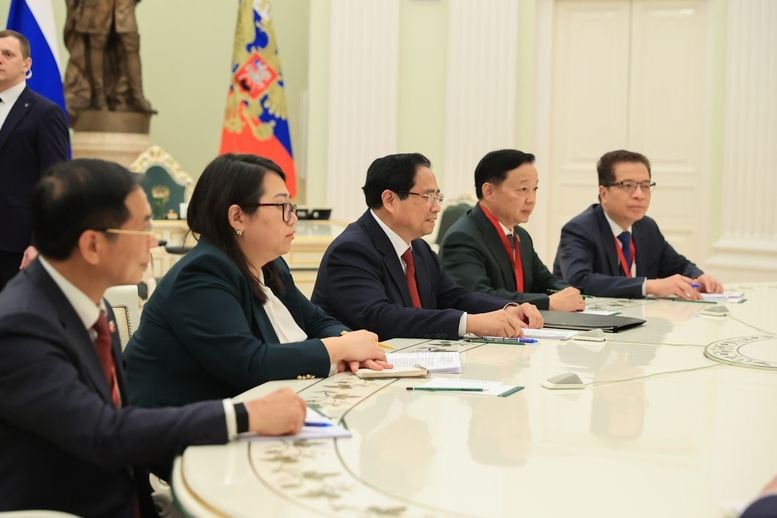
On March 25, during an official visit to the Russian Federation, Prime Minister Pham Minh Chinh met President Vladimir Putin at the Kremlin in Moscow. President Putin conveyed regards and health wishes to General Secretary To Lam, President Luong Cuong, and other senior Vietnamese leaders, and congratulated Vietnam on the successful 14th National Congress of the Communist Party and the elections to the 16th National Assembly and People’s Councils at all levels.
Putin said the visit—Phạm Minh Chính being the first senior Vietnamese leader to travel to Russia after the Party Congress—has significant meaning for continuing to maintain and promote bilateral cooperation. PM Pham Minh Chinh described Putin as a great friend who has made substantial contributions to the traditional friendship between Vietnam and the Russian Federation, helping deepen the relationship. He said he was satisfied with the positive development of bilateral ties in recent times, particularly after General Secretary To Lam’s official visit to Russia in May 2025 and a subsequent phone call between To Lam and Putin after the Party Congress, which helped shape strategic directions and create new momentum for cooperation across multiple fields.
The two sides affirmed the need to continue strengthening political trust through high-level and multi-channel exchanges, including Party, State, Government, National Assembly, localities, businesses, and people-to-people exchanges. They also agreed to maintain effective cooperation mechanisms, including the Intergovernmental Economic–Trade and Science–Tech Cooperation Committee, and to study and establish new cooperation mechanisms.
Leaders agreed to boost cooperation in economy, trade, and investment. They said they would encourage conditions for enterprises of both countries to do business and invest, promote enterprise connectivity, diversify markets and supply chains, and remove institutional barriers, payments, and transport obstacles. The goal is to raise bilateral trade to a balanced and sustainable level.
The leaders highlighted energy-oil and gas cooperation, science and technology, innovation, and infrastructure development as core areas aligned with each country’s development needs. They welcomed progress on negotiations and the signing of the agreement to build the Ninh Thuan 1 nuclear power plant in Vietnam, describing it as an important direction for energy security and sustainable development.
Putin pledged to instruct the Russian government to accelerate the next steps so the project can begin as a new symbol of Vietnam–Russia friendship in the new era. Both sides also supported increasing cooperation among energy and oil/gas companies on each other’s territory in line with international law.
The meeting emphasized strengthening cooperation in military-technical, security, and science/technology fields. PM Pham Minh Chinh praised Russia’s basic science and advanced technologies and proposed, based on the Vietnam–Russia Tropical Center cooperation, focusing on basic science, new technologies, high-tech, biomedicine, and aerospace.
Russia signaled it would consider visa exemptions for Vietnamese citizens. Both sides agreed to promote people-to-people exchanges and facilitate travel to boost tourism and attract more Russian visitors to Vietnam, as well as encourage more Vietnamese students to study in Russia.
The leaders exchanged views on regional and international issues of mutual concern and agreed to continue close cooperation at multilateral forums such as the United Nations and ASEAN, contributing to regional and global peace, cooperation, and development.
PM Pham Minh Chinh, on behalf of Vietnamese leaders, invited President Putin to visit Vietnam at a suitable time, and President Putin accepted the invitation.
Premium gym chains are entering a “golden era” that is ending or already in decline, as rising operating costs collide with shifting consumer preferences toward more flexible, community-based ways to exercise. Long-term memberships are shrinking, margins are pressured by higher rents and facility expenses, and competition from smaller, more personalized…