•
•
•
•
•
•
•
•
•
•
•
•
•
•
•
•
•
•
•
•
•
•
•
•
•
•
•
•
•
•
•
•
•


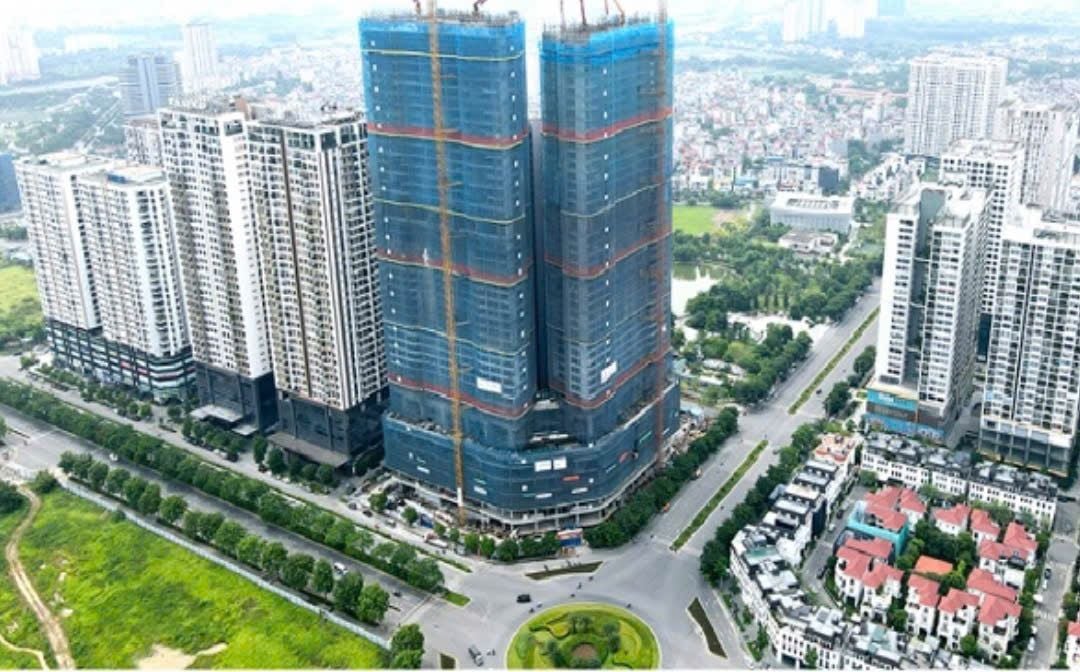
Any real estate project, whether for commercial housing or social housing, must undergo a complex investment process with multiple cost components. The costs that directly make up the product price include land costs, financing costs, and construction costs, among which construction costs are the most unpredictable variable, as building-material prices have recently fluctuated significantly. Against the backdrop of the real estate market continuing to show price growth in certain segments, the price level for apartments in major cities remains high. Specifically, in the inner city of Hanoi and the surrounding areas such as Gia Lam and Dong Anh, the Q1 2026 CBRE report shows that the primary price for condominiums averaged about 102 million VND per square meter, unchanged from the previous quarter but up 29% year-on-year. This level is higher than Ho Chi Minh City (formerly Saigon), where the average price was 91 million VND/m2 in the same period. Notably, since Q3 2025, Hanoi’s average primary-market price has consistently stayed above 100 million VND/m2. CEMENT PRICES HAVE RISEN BY OVER 7% According to the Vietnam Real Estate Brokers Association, any real estate project—whether commercial housing or social housing—must go through a complex investment process with multiple cost components. The costs that directly form the product price include land costs, capital costs, and construction costs; construction costs are currently the most volatile, given continuous fluctuations in building-material costs. Sharing about cement and building materials, the Vietnam Cement Association said: Building-material costs are entering a more pronounced upward trend driven by fuel costs. In March 2026 alone, cement prices rose by more than 7%, steel by more than 2%, floor tiles near 5%, while sand, stone and bricks surged 13.5%–23.3%... These developments imply that construction costs for projects could rise by about 1.91% to 8.09%. However, according to the Vietnam Cement Association, the pressure is not limited to fuel costs; there is also an imbalance in supply and demand of materials in the market. Notably, the shortage of construction sand is very serious, with on-site prices higher than published prices by 5%–35%, increasing financial risk and delaying construction progress. This makes sand a major bottleneck in the materials market. In addition, many limestone quarry sites have been halted or licenses revoked under new regulations, further tightening raw-material supply. “The synergy between rising input costs and restricted supply means the building-materials market is forecast to continue upward price trends and exhibit strong volatility in the near future,” the Vietnam Cement Association said. From a business perspective, these fluctuations are creating growing pressure. According to Vietnam Report, as many as 89.5% of enterprises confirm that material-price fluctuations are the biggest difficulty, given that sand and other materials in rapidly urbanizing areas continue to fluctuate. The pressure intensifies as external factors become less predictable. The geopolitical situation in the Middle East since early 2026 has caused the entire input-cost chain for construction—including fuel for machinery operation, transport, and material production—to rise in unison. LOCALITIES STEP UP PRICE-MANAGEMENT MEASURES TO STABILIZE PRICES Facing the rising cost of building materials, not only Hanoi, Hai Phong, Nghe An, and Can Tho, but recently Bac Ninh and Gia Lai have proactively implemented a series of measures to control costs, stabilize the market, and reduce pressure on investment in construction projects. In Bac Ninh, the Vice Chairman of the provincial People’s Committee instructed the Department of Construction to lead checks on compliance with price laws; strictly prevent hoarding, speculation, price gouging, or using market fluctuations to unjustifiably raise prices or disseminate inaccurate information that disrupts the market. In parallel, review the demand for building materials, ensure supply balance, prioritize key projects and urgent public works; and examine quarry reserves to accelerate licensing and boost extraction capacity. Alongside governance measures, Bac Ninh also focuses on strengthening collection and processing of price-related information for building materials, adhering to government and Ministry of Construction directives, to implement coordinated measures ensuring a secure material supply and stabilized prices. In particular, price disclosures and construction-price indices must be updated promptly and reflect current reality; for materials with unusual price fluctuations caused by fuel costs, monthly updates or earlier releases should be provided to support budget estimation and contract management. Authorities also monitor market developments; enhance analysis and price-forecasting, build scenarios of volatility, and assess impacts on total project investment. Based on this, timely advise appropriate policy responses to ensure effective project implementation. Similarly in Gia Lai, local authorities continue to implement coordinated measures. The provincial People’s Committee chair tasked the Department of Construction to propose remedies to alleviate difficulties for enterprises in the building-material sector. The Department of Finance is responsible for updating projects that produce high-tech, environmentally friendly building materials into the priority-investment list; and coordinating with relevant agencies to attract investment and embed development goals for this sector into the local socio-economic development plan. Local-level authorities at communes and wards are responsible for comprehensive management of building materials within their areas; directing regular inspections of extraction, transport, production, and sale of building materials, and strictly handling violations within their authority. Speaking at the April 21 session, representative Nguyen Duy Minh (Da Nang) argued that although there is a mineral-resource plan, access remains reactive. To address this, there is a need for price regulation mechanisms or strategic reserves for building materials; simplify licensing procedures for mining; and promote a circular-economy model in the building-materials sector.
Premium gym chains are entering a “golden era” that is ending or already in decline, as rising operating costs collide with shifting consumer preferences toward more flexible, community-based ways to exercise. Long-term memberships are shrinking, margins are pressured by higher rents and facility expenses, and competition from smaller, more personalized…