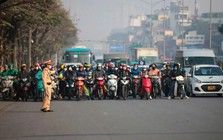
Hanoi will pilot restrictions on gasoline-powered motorcycles by specific time windows or defined zones within Ring Road 1, using a phased timetable rather than a blanket ban across the entire Ring Road 1. The plan is part of the city’s regional low emission approach under Resolution 57/2025/NQ-HĐND dated November 26, 2025.
At a press briefing on April 6, Deputy Director Dao Viet Long of the Hanoi Department of Construction said the restrictions will begin on July 1. From that date, gasoline-powered motorcycles will be banned according to set time windows or in designated zones within Ring Road 1.
Officials said the city’s approach is designed to implement low emission zones in stages, with a defined scope, timeline, and eligible subjects, rather than rolling out restrictions simultaneously across all of Ring Road 1.
Under Resolution 57, Hanoi’s schedule is as follows:
The Department of Construction also said Hanoi encourages commune-level People’s Committees to establish low emission zones within their jurisdictions.
To support the transition, the Department of Construction highlighted existing public transport capacity within the Ring Road 1 area. Hanoi already has two metro lines—Line 2A and Line 3.1—with total capacity of about 462,000 daily riders, and 45 subsidized bus routes with capacity of over 903,000 daily riders.
The city is seeking to maximize the share of green buses operating within Ring 1 before the pilot begins, prioritizing routes that run directly within the pilot area.
In Q2, Hanoi plans to add more public bike stations to address last-mile gaps. The city will also study additional small electric bus routes suitable for narrow alleys within the ring.
Regarding park-and-ride, the Department of Construction is developing plans to place parking lots at gateway locations adjacent to the pilot area. The goal is to allow residents to park privately and transfer to public transport.
Officials said that initially, more than 210 locations in Ring 1 areas have been surveyed, with data collection continuing.
On charging infrastructure and battery swapping stations, authorities are finalizing the regulatory fire-safety framework for charging stations under older apartment basements.
The inter-agency working group under Decision 3763/QD-UBND dated July 14, 2025 has proposed a plan to prioritize compact battery swapping kiosks in suitable public spaces. The proposal aims to enable 2–3 minute battery swaps while addressing fire safety and space constraints in older apartment blocks and the old quarter.
The plan has been submitted to the Hanoi People’s Committee and is expected to be implemented soon. Officials said actual installation would take about 1–3 days after procedures are completed.
Hanoi is coordinating to finalize a draft resolution on policies to support the transition to clean energy vehicles for consideration by the city’s People’s Council. The policy framework is intended to clearly target beneficiaries, with officials emphasizing that residents—especially low-income groups—should not be disadvantaged during the transition. Specific details will be announced after approval.
The head of the Department of Construction said the low emission zone is not only an administrative measure but a phased shift in urban transport, with residents’ benefits safeguarded at each step. The People’s Committee will direct agencies to periodically assess and adjust the plan to ensure residents have enough time to prepare before each expansion.
The Tax Authority also encouraged residents to use eTax Mobile and the National Public Service Portal for related actions.