•
•
•
•
•
•
•
•
•
•
•
•
•
•
•
•
•
•
•
•
•
•
•
•
•
•
•
•
•
•
•
•
•

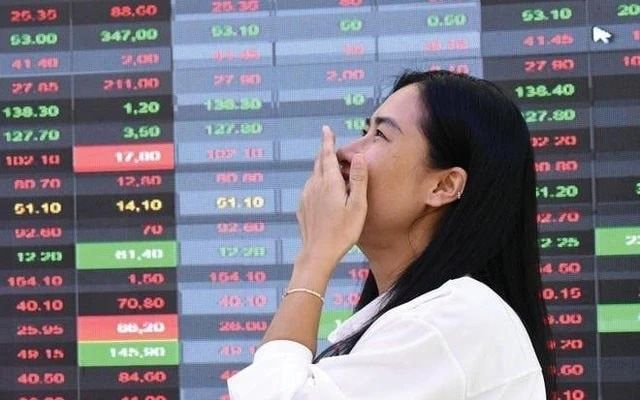
Stock price volatility became the focus of a question-and-answer session with the leadership of Phat Dat Real Estate Development Joint Stock Company (PDR) at its annual general meeting on the morning of April 16, after multiple shareholders asked Chairman of the Board Nguyen Van Dat to comment on his personal trading motives and the company’s share price.
In about half an hour, at least five shareholders asked Nguyen Van Dat to explain his trading activity and the reasons behind PDR’s stock price movements. Dat said the price level around 15,000 dong was “sad” and not what management expected, adding that the company has worked to improve business results but the share price has not reflected those efforts.
Dat said the decline was driven by market movements. He also reiterated that PDR shares should trade above 30,000 dong, citing the company’s fundamentals and the involvement of many investors in co-developing projects.
Dat said that last year he sold 88 million shares held personally to support the company’s capital. He noted that the sale occurred after the share price rose nearly 30%, from about 19,000 dong to 25,000 dong within a month. He described the transaction as sacrificing short-term gains to deliver longer-term, sustainable benefits for the company and shareholders.
He estimated the proceeds from selling his personal assets at about 2.2 trillion dong, saying the funds could support larger-scale business plans. About half a year later, Dat filed to buy back 3 million shares when the price was around 15,000 dong, and the buyback was completed about a week before the meeting.
Some shareholders raised concerns about self-dealing, which Dat denied. He said that if he had intended to profit personally, he would not have sold at 25,000 dong but waited for a higher price of 1.5x to 2x. “I am not trading for myself; I want to have the resources to support the company when needed. Now that I have money, I am buying back. True or not, it is the shareholders’ right,” Dat said.
Dat suggested that if the company executes its major plans, the stock could return to its historical price level. He said the strategy rests on two main pillars: commercial real estate and BT (build-transfer).
Phat Dat plans to construct and sell six commercial projects this year, including four in Ho Chi Minh City. The portfolio spans residential high-rise developments, housing estates, mixed-use commercial-service projects, and tourism and urban redevelopment projects.
For BT projects, the company said it will address backlog work and gradually implement new ones. It plans to stop the Phan Dinh Phung Sports Center project in Ho Chi Minh City, which has a total investment of nearly 2,000 billion dong.
Instead, the company proposes two projects: a cancer hospital and an elevated road, with a combined value of about 24,000 billion dong. Dat said that upon completion, the company will be paid by the state with land to recover the investment.
In recent years, most of Phat Dat’s revenue and profit have come from project divestments. Many investors and partners have questioned why the company does not focus more on retail sales and instead emphasizes mergers and acquisitions.
Dat said the approach reflects flexible business management. He said the company faced difficulties and needed to maintain operations, so it divested projects to focus on cash flow. “This year is no exception. We will continue to divest projects that generate more money,” he said, adding that the strategy ultimately benefits shareholders.
Bui Quang Anh Vu, General Director of Phat Dat, said project divestment is part of the restructuring process. The company prioritizes exiting projects whose product structure requires a long development time, shifting toward projects with faster turnover to reduce financial pressure amid volatile bank loan rates.
Vu also said the company is restructuring its investment portfolio geographically, focusing on Ho Chi Minh City and Dong Nai.
Phat Dat expects total revenue this year to reach 8,830 billion dong and pre-tax profit of 1,788 billion dong. Compared with the previous year, these figures are projected to rise by 350% and 174%, respectively.
Bitcoin (BTC) investors who use steady dollar-cost averaging (DCA) may be underperforming versus strategies that adjust exposure to the market’s cycle, according to new research arguing that Bitcoin’s behavior differs from traditional long-duration assets.
In a report cited by Markus Thielen of 10x Research, Bitcoin’s market…