•
•
•
•
•
•
•
•
•
•
•
•
•
•
•
•
•
•
•
•
•
•
•
•
•
•
•
•
•
•
•
•
•


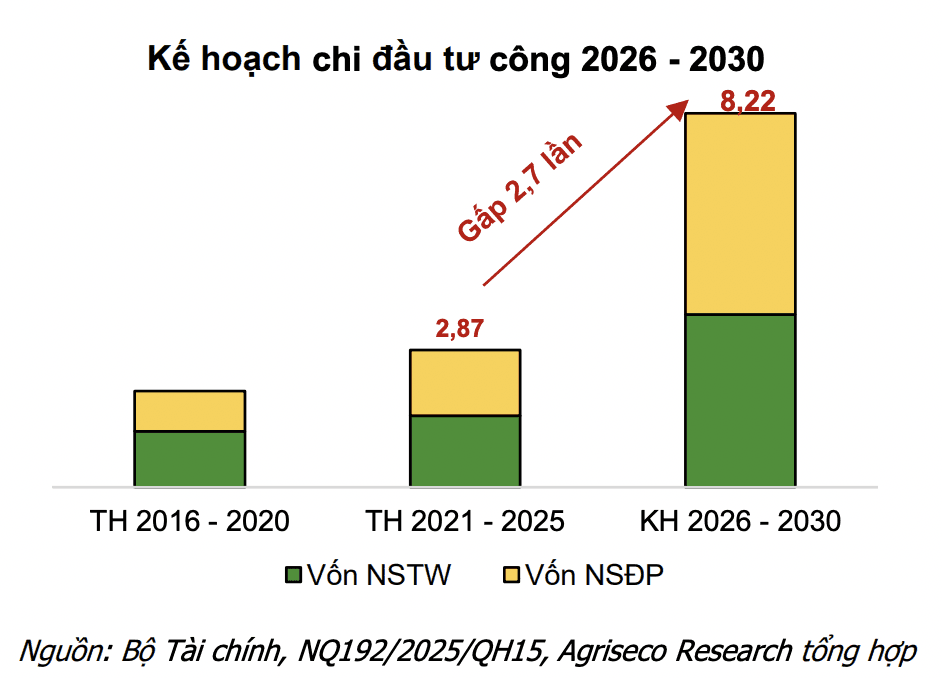
Promoting the disbursement of public investment is expected to generate spillover effects across multiple sectors, including construction materials, infrastructure construction, electrical installation, real estate and logistics.
The 2026 public investment plan is the highest among the years. Total public investment capital for 2026 is about 995 trillion VND, up more than 30% from 2025. If including additional funds, total funding now stands at about 1,008.61 trillion VND, equivalent to 7.85% of nominal GDP in 2025.
Against a backdrop of a volatile global economy, the Middle East conflict, and the United States’ retaliatory tariffs on Vietnam, the pace of public investment disbursement is particularly important for supporting growth.
The Government has asked ministries, sectors and localities to strive for 100% disbursement of the plans versus 95% previously. The focus is on completing key projects, including Beltway 3 and Beltway 4 in Ho Chi Minh City, Beltway 4 in Hanoi, the North–South high-speed railway, the Lào Cai–Hà Nội–Hải Phòng railway, and road bridges (Tu Liên, Trần Hưng Đạo, Ngọc Hồi, …). It also includes airport projects (Long Thành, Gia Bình), energy projects (Ninh Thuận Nuclear Power Plant), and large urban areas such as Cần Giờ and Olympic.
In the stock market, public-investment-related stocks have seen strong recoveries since the start of 2026. Agriseco Securities said the group still has room to accelerate further in the near term.
Public investment is viewed as a growth driver as other drivers—consumption and exports—are expected to grow more slowly amid global volatility.
According to calculations by the General Statistics Office, a 1% increase in disbursement could help GDP grow by about 0.058 percentage points. The large-scale public investment package, together with improved progress and decisive policy management, is described as a key foundation for achieving a 10% GDP growth target in 2026.
The disbursement push is expected to benefit construction materials and related industries as projects move from land clearance into construction through completion.
The infrastructure construction group is expected to benefit directly from executing key public investment projects. Transport infrastructure projects cited include the Bắc Nam expressway, Bắc Nam railway, Long Thành airport, Gia Bình, Beltway 3 in Ho Chi Minh City, Beltway 4 in Hanoi, Trong Dong Stadium and Can Gio.
The value of new contracts is expected to grow, helping firms expand backlog and maintain cash flow—particularly large contractors with project-execution experience. However, margins may be affected by sharp increases in input material costs, which account for 65–70% of total construction costs.
The electrical infrastructure construction group (transformers, transmission lines) is expected to benefit as the Government promotes energy infrastructure to ensure energy security. This is described as creating a new growth driver, including through attracting FDI and enhancing national status, with examples including 500kV transmission line projects, renewable energy, LNG-fired power and hydropower. The article notes that power shortages currently hinder FDI into Vietnam.
The electrical installation group is expected to benefit most clearly from rising work volumes as electricity demand increases, especially in industrial zones and manufacturing centers. It also points to supportive policies including the Electricity Law (amended) 2024, Power Plan VIII, restarting the Ninh Thuận Nuclear Plant, developing renewable energy projects, LNG-fired power and offshore wind.




Premium gym chains are entering a “golden era” that is ending or already in decline, as rising operating costs collide with shifting consumer preferences toward more flexible, community-based ways to exercise. Long-term memberships are shrinking, margins are pressured by higher rents and facility expenses, and competition from smaller, more personalized…




